The 6-burner range is the Honda Civic of the kitchen. It’s not sexy, but if it doesn’t start in the morning, nobody eats.
I have personally cooked on Vulcan, Southbend, and Garland ranges for thousands of hours. I’ve burned my arms on their doors and kicked their kickplates. Here is the honest breakdown of the “Big Three” and why one of them is the king of reliability.
1. Vulcan Endurance (The Durable Choice)
- Best For: High-volume lines where abuse is rigorous.
- The Standout Feature: Flashtube Pilots and MIG-Welded Frame.
Most ranges have one pilot light per burner. The Vulcan Endurance uses a “Flashtube” system, meaning one pilot lights two burners. Why I love this: It’s protected from boil-overs. When your new grill cook spills a gallon of pasta water, it won’t snuff the pilot.
- BTU: 30,000 per burner.
- Oven: The “Baker’s Depth” oven fits sheet pans side-to-side or front-to-back.
- Grit Factor: The MIG-welded frame is rock solid. I’ve seen line cooks stand on the open oven door (don’t do this) and it didn’t bend.
2. Southbend S-Series (The Heater)
- Best For: Sauté stations that need instant searing power.
- The Standout Feature: High-Output Burner Options (Up to 33k).
Southbend offers a standard 28,000 BTU burner, but their “Ultraline” or S-Series 33k BTU options put a flamethrower on the stovetop.
- Why it matters: Recovery time. When you drop a cold pan on the burner, how fast does it bounce back? Southbend is aggressive.
The Downside: I have found their oven door springs to be the weak point. After about 3 years of heavy Friday night slamming, the door tends to sag slightly, leaking heat into the kitchen.
3. Garland G-Star (The Precision Tool)
- Best For: Fine dining or space-constrained lines.
- The Standout Feature: Starfire Burners.
Garland uses a unique star-shaped burner pattern. Instead of a ring of fire, it shoots heat towards the center of the pan. This is excellent for smaller pans (saucier work) because the heat doesn’t just lick up the sides of the pot.
Deep Dive: The Anatomy of a Commercial Range
To understand what you are paying for, you need to look under the hood.
The Burner Geometry: Ring vs. Star
- Standard Ring Burner (Vulcan/Southbend): Fire comes out in a circle.
- Physics: Heat travels up the sides of the pan. Great for large stock pots.
- Flaw: Creates a “Cold Spot” in the dead center of the pan.
- Star Burner (Garland): Fire comes out in a star shape.
- Physics: Heat is directed inward.
- Win: Eliminates the cold spot. Better for delicate sauces.
The #1 Failure Point: The Oven Door Hinge
Every range I have ever owned eventually has a door failure.
- The Mechanism: It’s a spring-loaded hinge.
- The Abuse: Cooks open the door and “drop” it. Or they stand on it to clean the hood (OSHA violation, but it happens).
- The Result: The spring stretches. The door doesn’t seal tight.
- The Test: Turn the oven to 400°F. Hold a dollar bill near the top of the door. If it flutters, your seal is bad, and you are wasting $50/month in gas.
The “Cleaning” Scenario
It’s 2:00 AM. The shift is over. Your tired line cooks need to clean the range.
Vulcan Endurance:
- Pull-Out Tray: The crumb tray pulls out easily.
- Surface: The burner grates are heavy cast iron, but they fit in the dishwasher.
- Verdict: 8/10 Ease of Cleaning.
Southbend S-Series:
- Enamel: The oven interior is enameled, which helps, but the back panel is hard to reach.
- Verdict: 7/10 Ease of Cleaning.
Garland:
- Star Burners: These are harder to clean. Debris gets stuck in the “star” crevices. You have to use a wire brush.
- Verdict: 6/10 Ease of Cleaning.
Compliance & Safety: The “Fire Marshal” Checklist (NFPA 96)
Before you install, check these 3 things or you will fail inspection.
- The “Fryer Gap”: You must have 16 inches of space between an open flame (Range) and a Deep Fryer to prevent oil splashes from catching fire. If you don’t have space, you MUST install a stainless steel “Splash Guard” (baffle) between them.
- Legs are Mandatory: Never install a range directly on a wood floor. You need 6-inch legs or casters to provide air gap insulation. Without them, the radiant heat can carbonize the subfloor and start a fire years later.
- Pressure Regulator: Every range needs one. If you hook up “Street Pressure” natural gas directly to the manifold, you will blow the valves.
Head-to-Head Comparison
| Feature | Vulcan Endurance | Southbend S-Series | Garland G-Star |
|---|---|---|---|
| Top Burner BTU | 30,000 | 28,000 (33k Option) | 33,000 (Starfire) |
| Pilot System | Flashtube (Protected) | Standard | Standard |
| Oven Interior | Porcelain | Porcelain | Porcelain |
| Build Quality | Excellent (MIG Welded) | Good | Good |
| Burner Shape | Ring | Ring | Star (Even Heat) |
| Cleaning | Easiest | Medium | Hardest |
The Review Video
This breakdown shows the Vulcan Endurance features in detail, highlighting that Flashtube pilot system I mentioned.
Watch: Vulcan Endurance Range Review
Frequently Asked Questions (FAQ)
Q: Do I need a pressure regulator? A: YES. Every commercial range needs a gas pressure regulator. Usually, it comes in the box. If you connect high-pressure street gas directly to the range without one, you will blow the valves and create a 3-foot flame.
Q: Can I install this on a wood floor? A: NO. You need legs (6 inches minimum). If you take the legs off and sit it on wood, the heat downward will eventually cause pyrolization of the wood and start a fire under the floor.
Q: What is “Step-Up” configuration? A: A Step-Up range has the back burners raised 4 inches higher than the front. This prevents you from burning your forearm on the front pots while reaching for the back.
If your range breaks, you don’t have a restaurant. You have a cold sandwich shop. The commercial range is the heart of the line. But buying one is confusing. Do you need open burners or a hot top? A convection base or a standard oven?
According to Vulcan Equipment, the industry is shifting towards sealed burners for easier cleaning, but many chefs still prefer the raw power of open cast-iron burners.
This guide explains the difference between 30,000 BTU and 35,000 BTU burners, and why “Residential” ranges are illegal in a commercial kitchen.
Top 3 Commercial Range Recommendations
The range is the heart of the line. Don’t buy a toy.
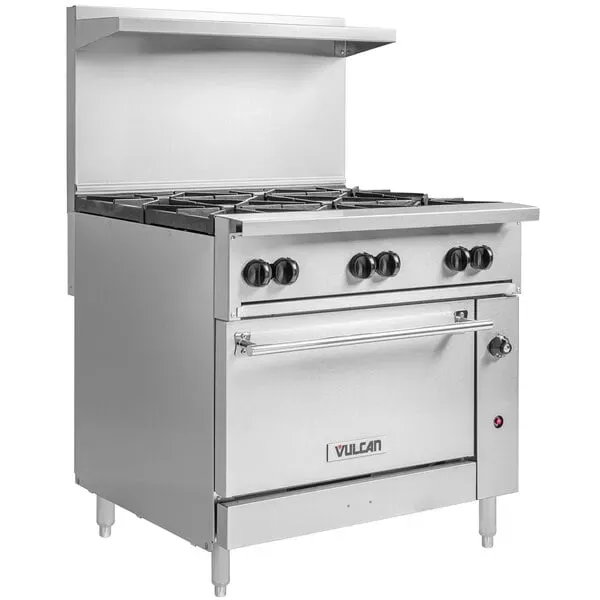
1. Best Overall (The Tank): Vulcan Endurance Series (36S-6BN)
- Best For: High volume, abusive kitchens (Universities, Hotels).
- Why It Wins: The Flashtube Pilot system is a game changer. One pilot lights two burners, and it’s protected from spills. You won’t be relighting it with a lighter during dinner rush.
- Durability: The MIG-welded frame is indestructible.
2. Best for Power (The Flamethrower): Southbend S-Series (S36D)
- Best For: Steakhouses, Sauté stations requiring high heat.
- Why It Wins: 33,000 BTU burners. It boils water faster than anything else.
- Trade-off: The oven door springs are a known weak point after 5 years, but the raw power is worth it.
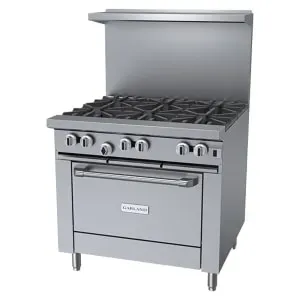
3. Best for Finesse (The Scalpel): Garland G-Star (G36-6C)
- Best For: Fine dining, complex saucier work.
- Why It Wins: The Starfire Burner distributes heat evenly across the whole pan bottom, eliminating the “hot ring” you get with standard round burners.
- Control: The valves offer better low-simmer control than Southbend.
Final Summary
If you need brute force, buy Southbend. If you need precision sauce work, buy Garland. If you want a machine that will never die, buy Vulcan.