The Griddle (or Flat Top) is the short-order cook’s best friend. It handles eggs, pancakes, burgers, and cheesesteaks simultaneously. But the difference between a $800 griddle and a $3,000 griddle is massive. It’s called Recovery Time.
Companies like AccuTemp Products have revolutionized the market with Steam-Heated griddles that have zero cold spots, unlike traditional gas plates.
This guide explains Plate Thickness (1/2” vs 1”), Chrome vs Steel, and why specific thermostats matter. When I was running a burger pop-up in 2018 (Restaurant #3), I made a fatal mistake. I bought a cheap, 24-inch countertop griddle from a “discount” brand. It looked shiny. It got hot. But the moment I dropped four cold smash burgers on it, the temperature plummeted from 400°F to 250°F. The recovery time was so slow that the meat started to steam in its own juices. I served gray, rubbery burgers. I almost went out of business.
Here is what I learned the hard way: In the world of griddles, Mass is everything.
If you are buying a griddle for a commercial kitchen, you are not buying a stove. You are buying a thermal battery. This guide will teach you how to choose the right one so you never serve a gray burger.
Deep Dive: The Physics of Plate Thickness
Go to a restaurant supply store and look at the spec sheets. You will see “Plate Thickness” listed: 1/2”, 3/4”, or 1”. Most people ignore this. DO NOT IGNORE THIS.
1. The 1/2” Plate (The “Breakfast Special”)
- Thermal Mass: Low.
- Behavior: It heats up fast (10 minutes). It loses heat instantly.
- Best For: Pancakes, eggs, bacon, reheating tortillas.
- Do Not Use For: Frozen burgers, steaks, or heavy loads.
2. The 1” Plate (The “Heavyweight”)
- Thermal Mass: Massive. It is a slab of steel.
- Behavior: It takes 30 minutes to heat up. But once it is hot, it stays hot. You can drop 20 cold steaks on it, and the temperature will barely dip.
- Best For: High-volume lunch spots, Steakhouses, Smash Burger joints.
Chef’s Rule: If you are cooking protein (meat), you Must Buy 1-Inch Thick.
Chrome vs. Steel: The “Mirror Finish” Debate
90% of griddles are Polished Steel. 10% are Chrome. Why pay double for Chrome?
1. Polished Steel (Standard)
- Appearance: Dull grey metal. Turns black over time (carbon buildup).
- Physics: Steel is porous. Food sticks to it until it is “seasoned” (polymerized oil).
- Heat Emission: Dark steel radiates heat out. Stand in front of a 48” steel griddle, and your apron will catch fire. It heats the kitchen.
- Cleaning: Brutal. You use a “Grill Brick” (pumice stone) and scrub until your arm falls off.
2. Chrome (The Premium Upgrade)
- Appearance: A mirror. You can shave in it.
- Physics: Smooth surface. Food releases instantly.
- Heat Retention: Because it is shiny, it reflects the heat back into the plate (and the food). It does not radiate heat into the room.
- Benefit: Your kitchen is 15 degrees cooler. You use 30% less gas.
- Cleaning: Delicate. You use a razor blade and water. NEVER use a grill brick. If you scratch the chrome, it peels, and the Health Department condemns it.
Verdict: Buy Chrome for open kitchens (where customers see the equipment) or for breakfast diners (eggs slide right off). Buy Steel for burger joints where you are scraping hard.
The “Chef’s ROI” Calculator
Is the expensive Vollrath ($2,500) worth it over the cheap generic ($800)?
Scenario: A Smash Burger joint doing 300 covers at lunch.
| Feature | Generic Import (1/2” Plate) | Vollrath Cayenne (1” Plate) |
|---|---|---|
| Recovery Time | Slow (2-3 mins between batches) | Instant (0 mins) |
| Burgers per Hour | 60 | 120 |
| Ticket Times | 15 Minutes | 8 Minutes |
| Customer Satisfaction | Low (Gray meat) | High (Crusty sear) |
| Gas Usage | High (Always on max) | Efficient (Thermostat works) |
Conclusion: The cheap griddle bottlenecks your entire restaurant. The expensive griddle allows you to double your sales.
The “Zoning” Strategy
A professional line cook uses the griddle like a piano. Different keys (zones) play different notes.
Standard commercial griddles have one burner every 12 inches. Let’s look at a 36-inch (3-Burner) setup.
The “Left-to-Right” Flow
- Zone 1 (Left) - The Inferno (400°F):
- This is your sear zone. Burgers, Steaks, Chicken Breast drop here.
- Technique: Drop the meat. Don’t touch it. Flip it. Move it to Zone 2.
- Zone 2 (Center) - The Cooker (350°F):
- This is where you finish the cooking process. Or where you toast buns.
- Technique: Move the burger here to melt the cheese.
- Zone 3 (Right) - The Warm / Egg Zone (250°F - 300°F):
- You might even leave this burner OFF. The heat bleeding over from the center is enough.
- Usage: Scrambled eggs, bacon holding, keeping caramelized onions warm.
Chef’s Tip: Never cook eggs on the “Burger Side.” The carbon and grease from the burgers will turn your beautiful yellow eggs gray and spotted. Keep the Egg Zone sacred.
Gas vs. Electric: The Maintenance Wars
Gas (Natural or Propane)
- Thermostats: Most use a “Snap Action” thermostat. You hear it click on and off.
- Repair: Simple. It’s usually a thermocouple ($15 part) or a pilot light adjust.
- Performance: Instant, violent heat.
Electric
- Elements: Resistive coils embedded in the plate.
- Performance: Slower to heat up initially, but VERY even. No “hot spots” between burners.
- Repair: Nightmare. If an element burns out, it is often welded into the plate. You have to throw the whole griddle away.
- Usage: Only use electric if you are in a mall/airport with no gas line.
Cleaning Guide: How to Not Ruin Your Investment
I judge a cook by how his griddle looks at the end of the shift.
The “Brick” Method (Steel Only)
- Turn heat down.
- Pour a cup of oil on the plate.
- Take a Grill Brick (pumice stone).
- Scrub with the grain (front to back). Do not scrub in circles (it leaves swirls).
- Scrape away the sludge.
- Crucial Step: Pour vinegar or lemon juice (acid) on it to “bleach” the steel silver.
- Wipe clean with a damp rag.
- Re-season with a thin layer of fresh oil.
The “Chemical” Method (Scotch-Brite)
- Turn heat to 300°F.
- Pour a packet of “Grill Cleaner” (liquid glycerin/alkali).
- Let it bubble. The chemical eats the carbon.
- Scrub lightly with a green pad.
- Squeegee off.
- Safety Warning: Do not breathe the smoke. It is caustic. Wear gloves.
Frequently Asked Questions (FAQ)
Q: Can I use a Grill Brick on a Chrome Griddle? A: ABSOLUTELY NOT. You will scratch the mirror finish, ruining the non-stick properties. Use only a razor blade and water.
Q: How do I know if my plate is 1-inch thick? A: Look at the side profile of the plate (where the grease trough is). You can literally measure the steel slab with a ruler. If it’s 1/2 inch, it’s a breakfast griddle. If it is 1 inch, it is a heavy-duty meat griddle.
Q: Why won’t my pilot light? A: The Spark Igniter gap is likely too wide or coated in grease. Clean the electrode with a dry cloth or adjust the gap.
Top 3 Commercial Griddle Recommendations
Plate thickness defines your burger quality. Do not buy thin plates.
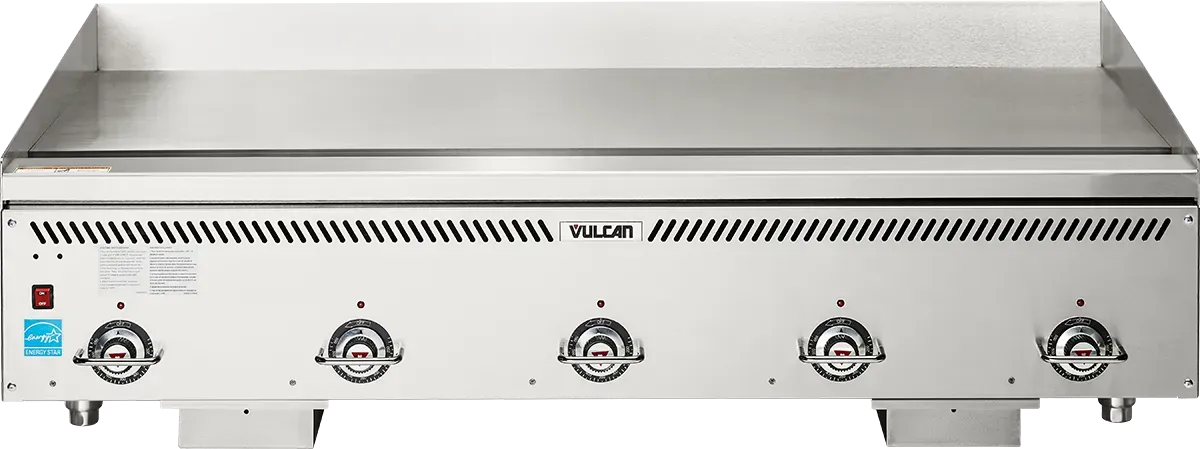
1. Best Overall (The Heavyweight): Vulcan VCCG Series (IRX)
- Best For: High volume smash burgers, Steakhouses.
- Why It Wins: Available with IRX (Infrared) burners that reduce gas usage by 20%, often meeting Energy Star standards. The plate is a full 1-inch thick slab.
- The Tech: Vulcan’s “Rapid Recovery” composite plate option transfers heat 5x faster than standard steel.
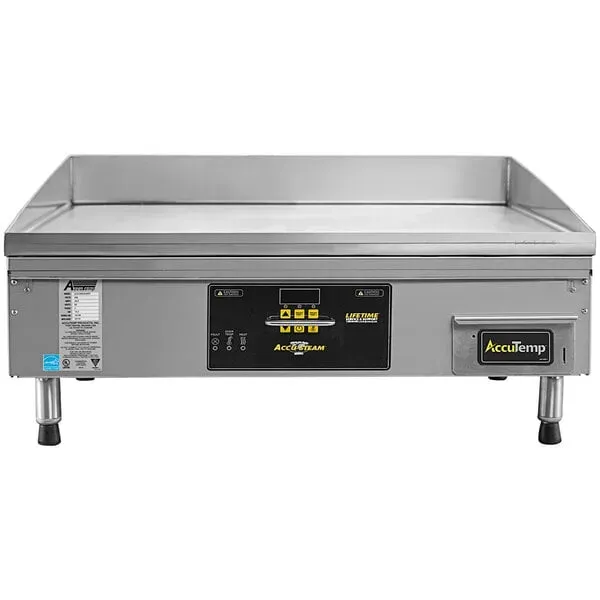
2. Best for Consistency (Steam Heated): AccuTemp AccuSteam
- Best For: Chains requiring 100% consistency (pancakes, eggs).
- Why It Wins: It doesn’t use burners under the plate. It uses a vacuum chamber of steam.
- The Result: There are Zero Cold Spots. Every square inch is exactly the same temp. You can cook on the corners.
3. Best Value (The Standard): Garland G-Series
- Best For: Diners, Breakfast spots.
- Why It Wins: Massive 28,000 BTU burners. It’s a simple, rugged workhorse that costs less than the Vulcan IRX but outperforms budget brands.
Final Summary
If you cook eggs/pancakes, buy AccuTemp (even heat). If you cook Smash Burgers (violent heat/recovery), buy Vulcan.