Let’s get one thing straight: You cannot make authentic Fried Rice or Pad Thai on a standard commercial range.
I tried. In my second restaurant (a fusion concept), I bought a standard 6-burner range and put a “wok ring” adapter on it. It was a disaster. The 30,000 BTU burner simply couldn’t recover heat fast enough. The rice didn’t fry; it steamed. The vegetables got soggy. There was zero Wok Hei (the smoky “breath of the wok” flavor).
Experts at Town Food Service, who carry the legacy of New York’s Chinatown kitchens, will tell you that true wok cooking requires focused, jet-engine heat to instantly vaporize water.
If you want to serve Asian cuisine at a commercial level, you need a specialized tool. You need a jet engine bolted to the floor.
This guide covers everything I learned from buying (and breaking) high-BTU wok ranges over the last 20 years.
The Physics of Wok Cooking: Why You Need 100,000 BTUs
Standard Western cooking is about conduction (pan touching heat). Wok cooking is about vaporization.
You toss the food into the air through a massive column of flame. This vaporizes the oil particles and creates that signature charred flavor. To do this, you need immense power.
- Standard Range Burner: 30,000 BTUs.
- Volcano Burner: 100,000 to 120,000 BTUs.
If your burner is too weak, the temperature of the wok drops below 350°F when you add the cold ingredients. The oil stops frying and starts soaking into the food. Result: Greasy, heavy food and angry customers.
Deep Dive: The Burner Types (Jet vs. Ring)
When you order a wok range (usually from Town Food Service, the undisputed king of this niche), you have to choose your engine.
1. The Jet Burner (The “Rocket”)
This is what you probably need.
- How it works: It looks like a showerhead made of brass tips (usually 16, 20, or 32 tips). It shoots raw gas and air straight up in a focused column.
- Sound: It sounds like a jet taking off. It is loud.
- Best For: High-volume stir fry. The heat is concentrated at the very bottom of the wok, where the oil is.
- Maintenance: The tips can clog with grease. You need to poke them with a wire periodically.
2. The Ring Burner (The “Flower”)
- How it works: Several concentric rings of flame, like a giant stovetop burner.
- Best For: Simmering massive pots of stock (Pho, Ramen broth), blanching noodles, or braising.
- Why avoid for stir-fry: The heat spreads out too much. It heats the sides of the wok, not just the “sweet spot.”
3. The “Soup” Burner (Warming)
- Some ranges come with a small back burner. This is just to keep a pot of oil or broth hot. Do not cook on it.
The Water Cooling System: A Non-Negotiable
If you look at a wok range, you will see a pipe dripping water across the back “deck” (the flat surface behind the burners).
This is not accidental.
- The Problem: The burners are so hot (120,000 BTUs) that they will literally melt the stainless steel deck if left unchecked. The steel will warp, buckle, and eventually crack.
- The Solution: A constant waterfall.
- Chef’s Rule: The water must be turned on before the gas. The moment you light the pilot, that water needs to be flowing.
- Plumbing Requirements:
- Fresh Water Feed: 1/2” cold water line.
- Drain: The range has a trough mechanism. You need a floor trough or a direct drain connection.
- The “Rice Trap”: You need a strainer basket in the drain. Rice grains will clog your building’s plumbing in 3 days.
The “Chef’s ROI” Calculator
Owners see the price tag ($3,000 - $6,000) and ask if they can just use a regular stove.
Scenario: A Thai takeout spot doing 150 orders of Pad Thai on Friday night.
| Feature | Standard Range (30k BTU) | Wok Range (100k BTU) |
|---|---|---|
| Cook Time per Order | 5-6 Minutes | 2 Minutes |
| Orders per Hour | 10 | 30 |
| Revenue ($15/order) | $150 / hour | $450 / hour |
| Friday Night (4 hours) | $600 | $1,800 |
| Difference | - | +$1,200 per night |
Verdict: The wok range pays for itself in one weekend. You physically cannot produce volume Asian food on a western range.
Installation Nightmares: Don’t Burn the Building Down
Installing a wok range is widely considered the hardest kitchen plumbing job.
1. Gas Pipe Sizing
This is where everyone fails.
- The Load: A 3-chamber wok range pulls 350,000 BTUs.
- The Pipe: You cannot feed this with a 3/4” Quick Disconnect hose. You need a 1-inch or 1.25-inch gas line (check NFPA 54 sizing tables).
- The Symptom: If your pipe is too small, when you turn on the third wok, the first two flames will shrink. This is “gas starvation.”
2. The Back Wall
This range kicks out catastrophic heat.
- The Shield: You need a stainless steel back splash.
- The Wall: Do not put this against drywall. Even with a shield, the heat transfer can char the wood studs inside the wall. It must be against masonry or have an “air gap” spacer.
3. The Knee Valve
Wok chefs don’t use their hands to control heat. They use their knees.
- The Lever: An L-shaped handle at knee height.
- The Action: Push right for HIGH heat. Release for LOW/Pilot.
- Maintenance: These valves get kicked 500 times a night. They wear out. Grease the linkage weekly.
Top 3 Commercial Wok Range Recommendations
If you don’t have at least 100,000 BTUs, you are making oatmeal, not fried rice.
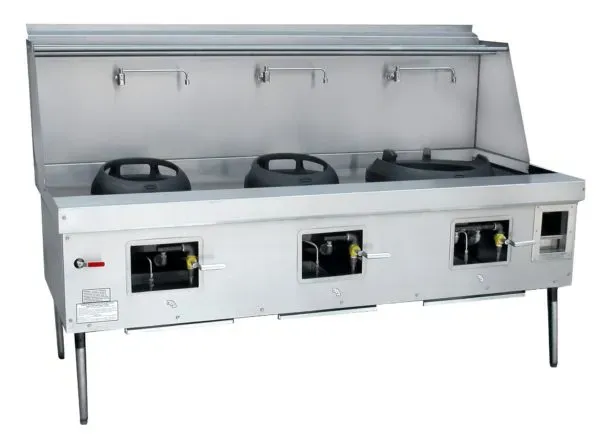
1. Best Overall (The Legend): Town Food Service MasterRange
- Best For: Authentic Chinese/Thai Restaurants.
- Why It Wins: Town defined this market in 1929. Their “Volcano” jet burners heat the oil to smoking point in 8 seconds.
- Customization: You can mix and match holes (13” to 30”) and burner types.
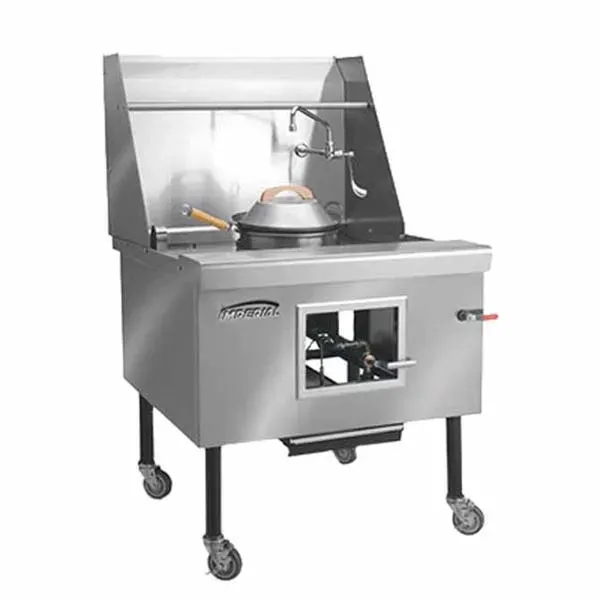
2. Best Value (Reliable Gas): Imperial ICRA Series
- Best For: Asian Fusion, Noodle Houses.
- Why It Wins: Imperial builds a tank. It’s slightly cheaper than a custom Town build but still offers 100,000+ BTUs per burner.
- Durability: The welded chassis can take the abuse of “wok tossing” all day long.
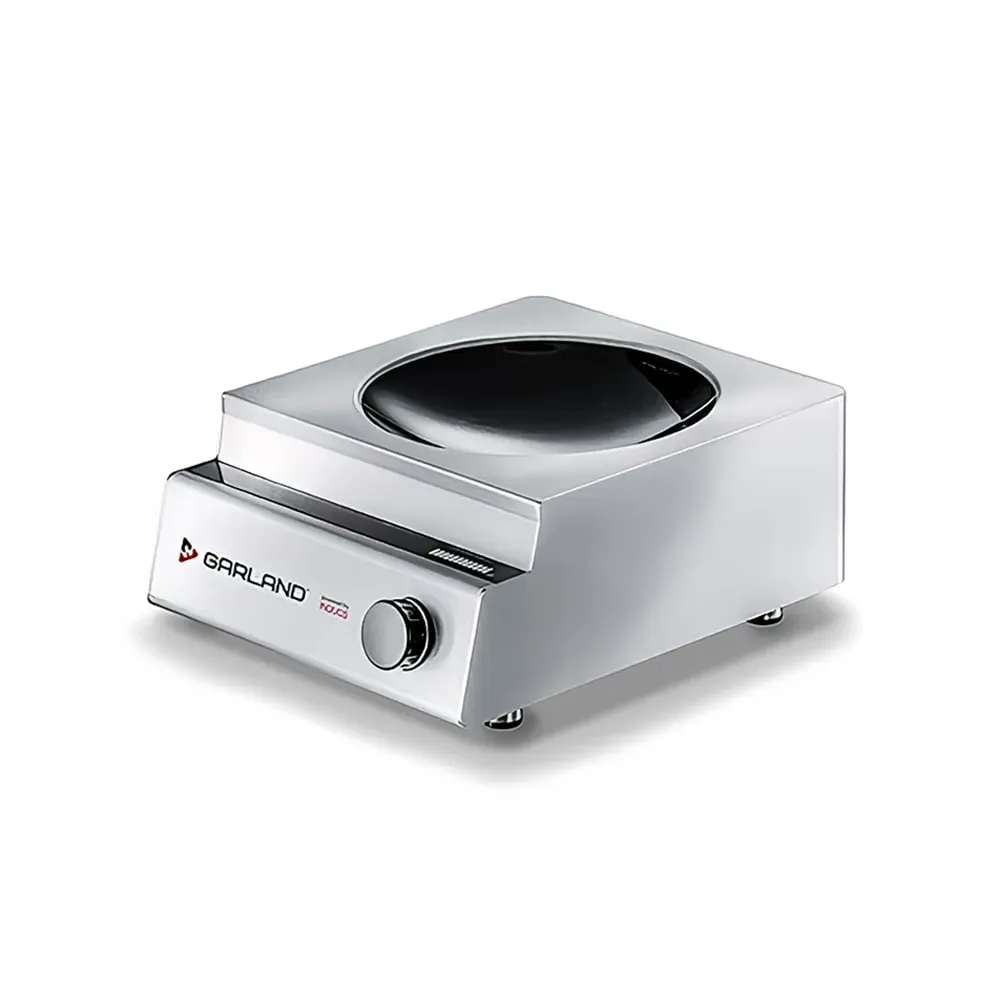
3. Best Electric (The Modern Pick): Garland Induction Wok
- Best For: Hotels, Casinos, Cruise Ships.
- Why It Wins: High-power induction (3.5kW or 5kW) creates immediate heat without the roaring noise and waste heat of gas.
- Efficiency: It runs cool. Your chefs won’t pass out from heatstroke.
Final Summary
If you have a gas line, buy Town. If you are electric only, buy Garland.
Related Articles
Troubleshooting Guide: Common Wok Range Failures
1. “The Jet Burner is Sputtering”
- Cause: Rice or sauce fell into the burner tips.
- Fix: Turn gas off. Use a welding tip cleaner or a paperclip to poke out the holes in the brass jets.
2. “The Deck is Warping / Popping Sounds”
- Cause: You aren’t running enough cooling water.
- Fix: Increase the flow rate on the waterfall valve. The deck should be cold to the touch even when cooking.
3. “The Pilot Light Keeps Dying”
- Cause: The “wok tossing” creates wind drafts that blow it out.
- Fix: Check the pilot guard shield. It might be bent or missing. Also, clean the pilot orifice—woks are messy, and grease gets everywhere.
Used Market Guide: Buying a Beater?
Buying a used wok range is like buying a used taxi. It has seen hard miles.
- Check the Refractory Brick: The burner chamber is lined with brick insulation. In used units, this is often crumbled or missing. Replacing it is messy and expensive ($500+).
- Check the Water System: Turn on the water. Look for leaks inside the cabinet. A rusted-out manifold means the unit is scrap.
- The Verdict: Only buy used if it’s a Town unit and the brick is intact. Otherwise, the repair costs outweigh the savings.
Frequently Asked Questions (FAQ)
Q: Can I install a commercial wok range in my home? A: Absolutely Not. The heat output (100k+ BTU) creates a fire hazard for wood studs and produces lethal CO levels. It voids home insurance.
Q: What is a “Water Cooled” deck? A: A continuous waterfall that runs across the top of the range to keep the stainless steel from warping/melting under the intense jet burner heat.
Q: Why is my pilot light yellow? A: It is clogged with grease or flour. Clean the orifice with a wire tip cleaner or compressed air to restore the blue flame.
Final Word: The “Swing Faucet”
One last tip from experience.
Every wok range comes with a tall “Swing Faucet” on the back to rinse the wok between dishes. These faucets leak. Always.
The O-rings inside cannot handle the heat radiating from the burners. Pro Tip: Buy a bag of high-temp O-rings/washers and keep them in the office. Change them every 3 months before they start spraying water all over your chef.
If you are cooking Asian food, this range is the heart of your kitchen. Treat it with respect, keep the water running, and it will make you millions.