A chef can cook a steak by “feel” (Rare = Sponge, Well Done = Tire). But a Health Inspector does not care about your feelings. They care about Data.
If your walk-in cooler is at 42°F instead of 41°F, you get a violation. If your chicken is at 163°F instead of 165°F, you kill someone with Salmonella.
The thermometer is not a cooking gadget; it is a Legal Defense Device. In this guide, I will explain why Dial Thermometers are trash, why Infrared guns are misunderstood, and how to calibrate your probe using the “Ice Bath” method.
1. The Technology: Bi-Metal vs. Thermocouple vs. Infrared
Bi-Metal Stem (The $5 Dial)
- Mechanism: A coil of two metals expands at different rates to turn a needle.
- The Flaw: Ideally, the sensor is in the tip. In reality, the sensor is the bottom 2 inches of the stem.
- The Failure: You cannot measure a thin hamburger patty with a bi-metal stem because the sensor is sticking out into the air.
- Response Time: Slow (15-20 seconds).
- Calibration: Drifts constantly if dropped.
- Verdict: Garbage. Keep one in your pocket for show, but never trust it.
Thermocouple / Thermistor (The Digital Pro)
- Mechanism: Two wires welded at the tip create a voltage drop based on temperature.
- The Sensor: It is in the extreme Tip (the size of a pinhead).
- Response Time: Instant (< 2 seconds).
- Accuracy: +/- 0.5°F.
- Verdict: Mandatory for food safety. Brands: Cooper-Atkins or ThermoWorks.
Infrared (The Laser Gun)
- Mechanism: Reads surface radiation.
- The Limit: It ONLY reads Surface Temperature.
- The Trap: If you shoot a laser at a soup, it reads 180°F (Steam). The center of the pot might be 120°F (Danger Zone).
- Use For: Checking receiving temps of palettes, checking freezer walls, checking pizza oven stones. NEVER for internal cook temps.
2. Calibration: The Ice Bath Protocol
A thermometer is useless if it is lying. You must calibrate it Weekly. Most Bi-Meters have a “Calibration Nut” under the dial. Digital ones have a “CAL” button.
Step-by-Step Guide:
- The Mix: Fill a large cup with Crushed Ice (to the top). Add cold water to fill the gaps.
- The Wait: Stir and wait 2 minutes. The water must be 32°F (0°C).
- The Dip: Submerge the probe 2 inches. Do not touch the sides of the cup.
- The Read:
- If it says 32°F: You are good.
- If it says 34°F: You are drifting. Twist the nut or hold the CAL button until it reads 32°F.
The Boiling Point Method (Advanced):
- Water boils at 212°F at Sea Level.
- Altitude Math: For every 1,000 feet of elevation, the boiling point drops ~2°F.
- Example: In Denver (5,000 ft), water boils at 202°F. If you calibrate to 212°F in Denver, you are wrong by 10 degrees. Stick to the Ice Bath; it is constant everywhere.
3. HACCP Logging: The Paper Trail
HACCP (Hazard Analysis Critical Control Point) is the documentation that proves you didn’t poison anyone.
Critical Control Points (CCPs):
- Receiving: Fish must arrive under 41°F. Shoot it with IR. If it’s 45°F, reject the delivery. Write it down.
- Cooking: Chicken to 165°F. Burger to 155°F. Probe it. Write it down.
- Cooling (The Danger Zone):
- According to the USDA, you have 2 hours to get food from 135°F to 70°F.
- You have 4 more hours to get from 70°F to 41°F.
- The Log: You must write down the time and temp every hour during cooling.
Digital Logging: Modern systems (like Cooper-Atkins Blue2) use Bluetooth probes. You poke the chicken, it beams the temp to an iPad. The cloud saves the record forever. Health Inspectors love this.
4. Troubleshooting: Why is my Walk-In Warm?
“Chef, the thermometer on the outside of the walk-in says 50°F!”
Don’t panic yet.
- Air Sensor vs. Product: The wall thermometer measures AIR. If someone left the door open for 20 seconds, the air warms up instantly. The block of cheese is still 38°F.
- The Solution: Use a Simulated Product Probe. This is a probe inside a bottle of glycol/liquid. It mimics the thermal mass of food. It tells you the temp of the tuna, not the breeze.
5. Types of Probes
- Needle Probe: Super thin. For sous-vide bags or delicate fish.
- Penetration Probe: Thick. standard.
- Surface Probe: Flat disc. For checking griddle temperature (350°F).
- Air Probe: Open cage. For ovens.
- Dishwasher Probe: A “Plate” with a memory chip. Run it through the machine to verify the Rinse cycle hits 180°F.
Top 3 Commercial Thermometer Recommendations
Don’t buy the $4 dial thermometer at the grocery store. It will cost you a Health Code violation.
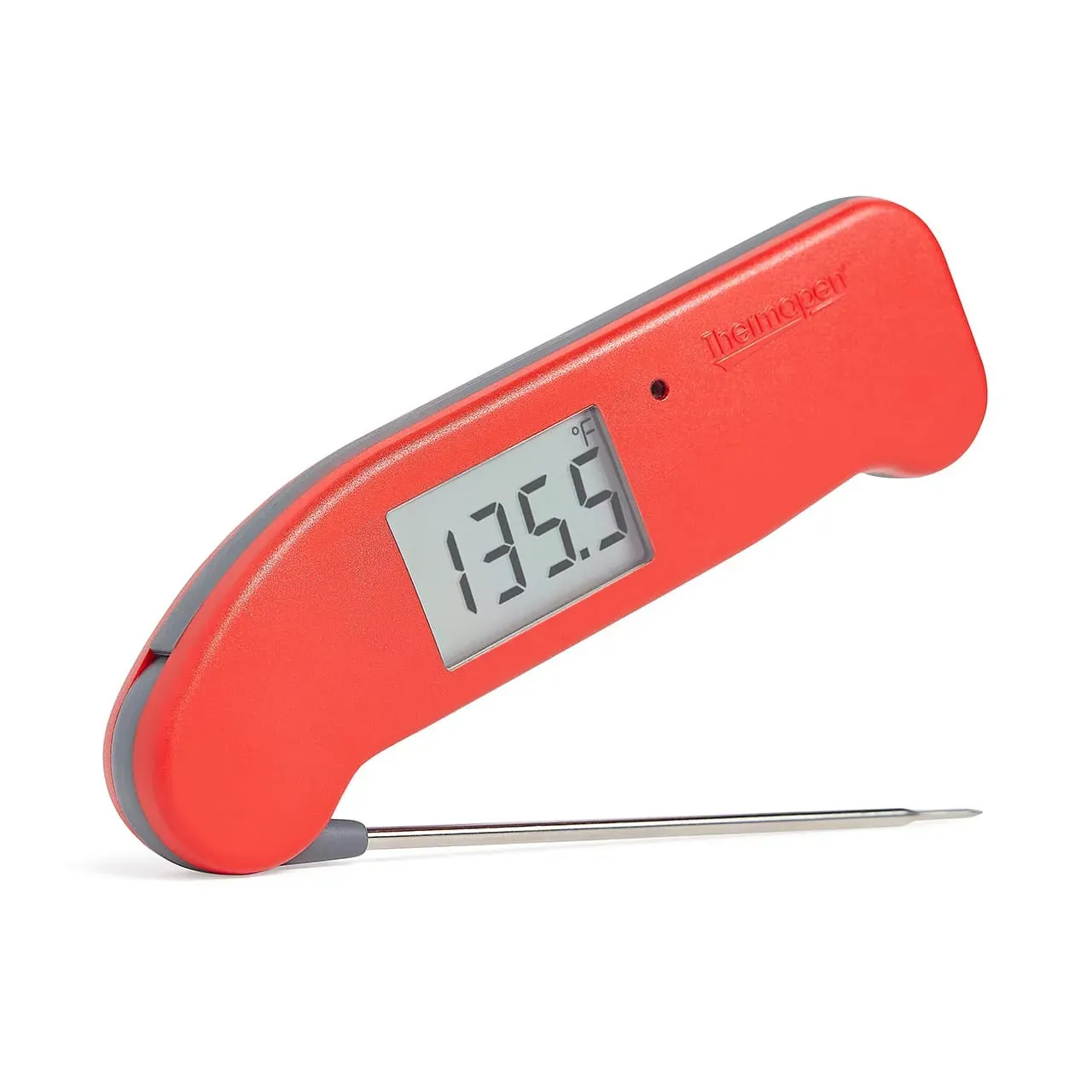
1. Best Overall (The Ferrari): ThermoWorks Thermapen ONE
- Best For: Executive Chefs, Health Inspectors, Sous Vide.
- Why It Wins: It reads in 1 second. The accuracy is ±0.5°F. It feels indestructible.
- The Feature: The display rotates automatically (great for awkward angles inside a lit oven). It is arguably the best kitchen tool ever made.
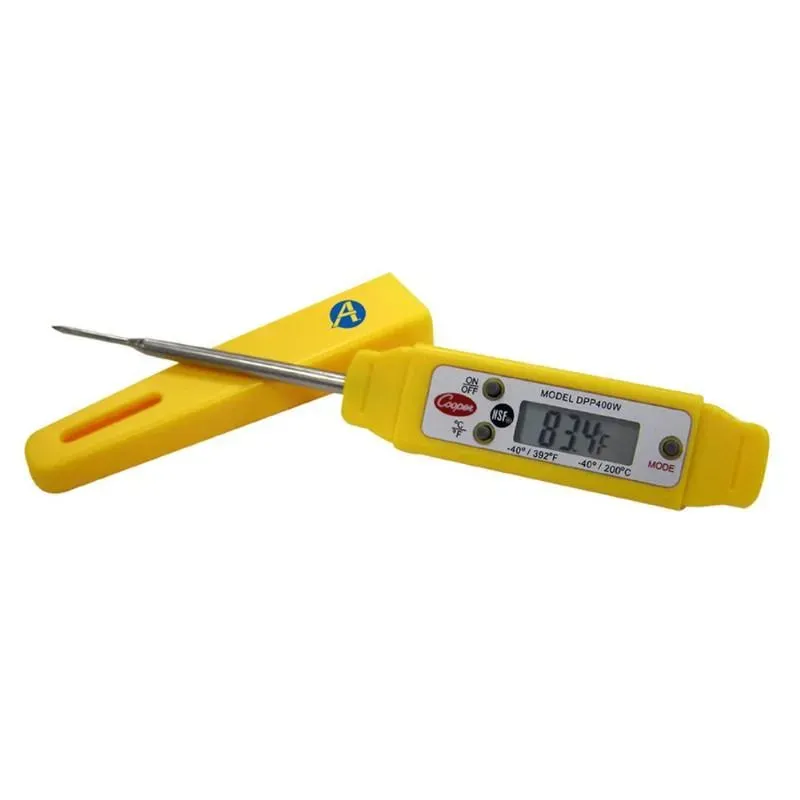
2. Best Value (The Standard Issue): Cooper-Atkins DPP400W
- Best For: Line Cooks, Prep Cooks, Dishwashers.
- Why It Wins: Waterproof. Durable yellow casing. NSF Certified. It takes about 6 seconds to read, but it costs ~$25 instead of $100.
- Durability: You can run it through the commercial dishwasher (though you shouldn’t), and it will survive.
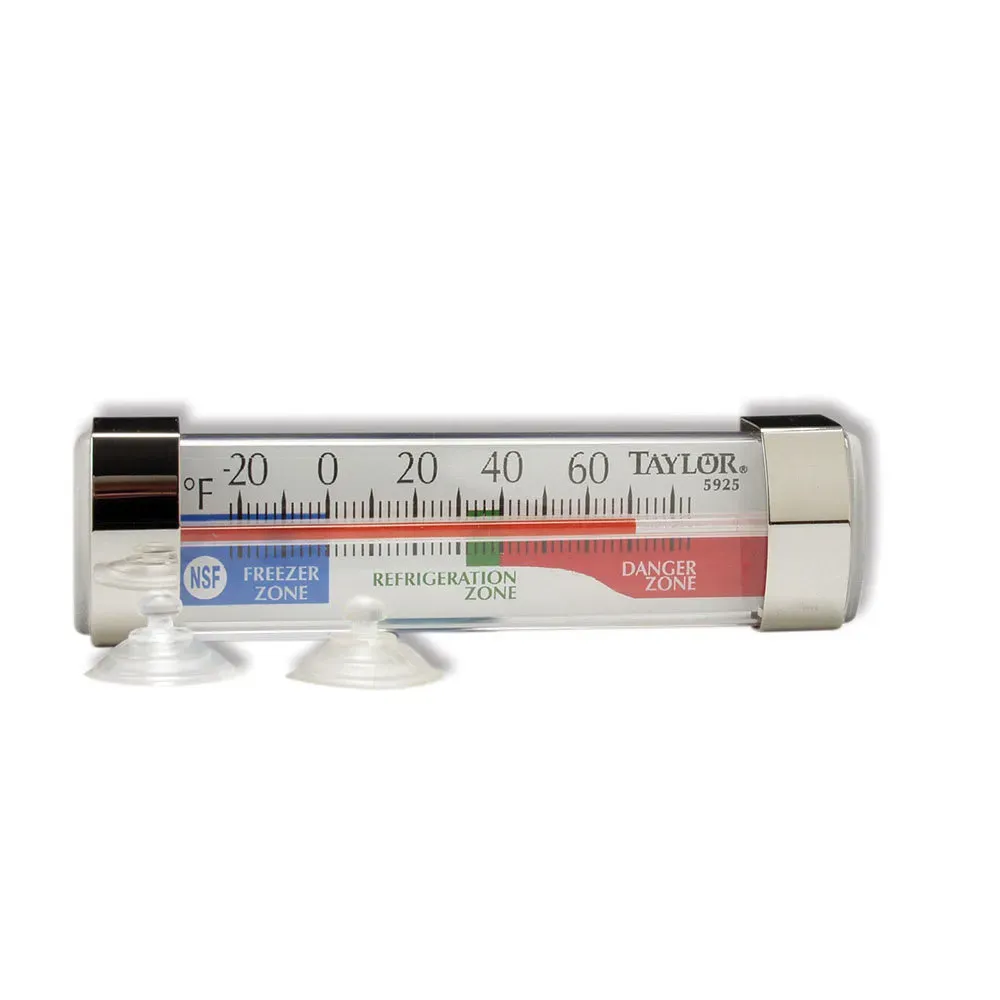
3. Best for Walk-Ins (Monitoring): Taylor 5925N Large Tube
- Best For: Hanging in the Walk-in Cooler and Freezer.
- Why It Wins: It is huge. You can read it from the door without walking in.
- The Fluid: It uses safe spirits (non-toxic), not mercury. If it breaks, you just have a mess, not a Hazmat scene.
Frequently Asked Questions (FAQ)
Q: Can I use an Infrared (Laser) gun to check chicken temp? A: Never. IR guns only measure the surface temperature. The surface might be 165°F while the internal center is still raw. Always use a probe.
Q: How do I calibrate my thermometer? A: Use the Ice Bath Method. Fill a cup with crushed ice and water. Submerge the probe. It should read 32°F (0°C). If not, hit the “Calibrate” button.
Q: Why is my bi-metal dial thermometer inaccurate? A: The sensor in a cheap dial thermometer is the bottom 2 inches of the stem. It cannot accurately measure thin foods like burgers because the sensor is exposed to the air.
Final Summary
Calibrate efficiently, measure frequently. Give every line cook a Cooper-Atkins, and keep the Thermapen in your pocket.