The Walk-In Cooler tells you everything about a Chef. If I see open cardboard boxes, raw chicken dripping on lettuce, and yogurt stored in old pickle buckets… I walk out. Storage is Inventory Control. If you can’t see it, you can’t count it. If you can’t count it, you over-order it.
In this guide, I will explain the Polycarbonate vs. Polypropylene war, why Square Containers are mandatory for small kitchens, and the sticky nightmare of Date Labels.
1. Material Science: Clear vs. Translucent
This is the “Coke vs. Pepsi” of kitchen storage.
Polycarbonate (Clear) - “The Camwear”
- The Look: Crystal clear. You can identify the product instantly.
- Durability: Indestructible. You can drop it on concrete.
- Acid Resistance: High. Tomato sauce will not stain it.
- Temperature: -40°F to 210°F.
- The Controversy (BPA): Contains Bisphenol A.
- Regulatory Update (US): The FDA monitors BPA use, but it is restricted in California for juvenile feeding products.
- Advice: If you serve schools or healthcare, switching to BPA-Free Copolyester (Camwear Plus) is recommended to stay ahead of future FDA bans.
- Verdict: The Professional Standard (for now).
Polypropylene (Translucent) - “The Milky”
- The Look: Hazy / Clouded. You have to squint to see if it’s onions or potatoes.
- Cost: 50% Cheaper.
- BPA Free: Yes.
- Staining: Terrible. If you store Chili in it once, it will be orange forever.
- Verdict: Good for dry storage (Flour, Sugar). Bad for sauces.
2. Geometry: Square vs. Round
Round Containers
- Physics: Better airflow around the container (Faster cooling).
- The Flaw: Wasted Space.
- Circles do not tessellate. When you put 4 round buckets on a shelf, there is a distinct “dead zone” diamond of air in the middle.
- Result: You enter “Storage Hell” where you run out of shelf space.
Square Containers
- Physics: They tessellate perfectly.
- The Math: Square containers hold 33% more volume per square foot of shelf space than rounds.
- The Win: If you have a small walk-in, switching to square containers is like building an addition to your kitchen.
3. Lids: The Color Code
HACCP is easier if you don’t have to read english.
- Green Lid: Produce.
- Red Lid: Raw Meat.
- Blue Lid: Seafood.
- Yellow Lid: Poultry.
- White Lid: Cooked / Dairy.
- Purple Lid: Allergen Free (Gluten Free / Nut Free). Critical for preventing anaphylaxis lawsuits.
The Seal: Snap-tight lids prevent “Cross-Flavoring.” You don’t want your Cheesecake tasting like the Onions stored next to it. Only a tight seal prevents this vapor exchange.
4. The “Mayonnaise Bucket” Trap
“Chef, I’ll just save the 5-gallon pickle buckets. Free storage!” NO.
- Smell: You can never wash the pickle smell out of the plastic. Your chocolate mousse will taste like dill.
- Health Code: Once a “Single Use Container” is empty, it is trash. It is not rated for re-use. The plastic scratches easeily, creating bacterial harborage points.
- Efficiency: Round buckets waste space.
Exception: You can use them for trash cans or compost bins. Just not for food storage.
5. Labeling: The Sticky Truth
You must date everything. “Day Dots” or masking tape.
- The Problem: Cheap adhesive leaves a sticky black residue when washed.
- The Result: You see containers with 5 layers of old tape residue. It looks gross.
- The Fix: Dissolvable Labels.
- Magic: They dissolve completely in hot water (dish machine). No scrubbing required.
- Cost: Expensive ($15/roll).
- Value: Beating the Health Inspector? Priceless.
Top Commercial Storage Recommendations
You need a system that stacks, seals, and abuses the competition.
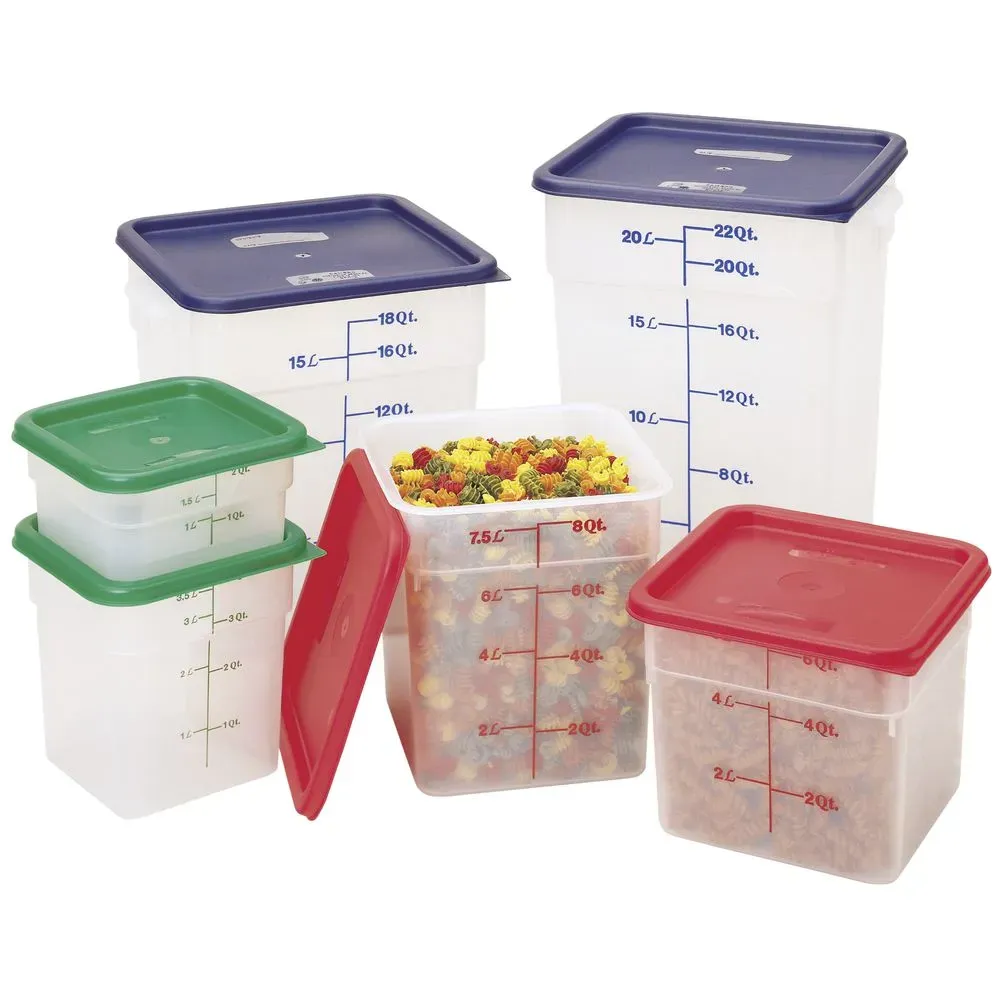
1. Best Overall (The Gold Standard): Cambro CamSquare (Clear Polycarbonate)
- Best For: Everything. Prep, sauces, cooler storage.
- Why It Wins: It is the definition of the industry standard. The “Midnight Blue” markings never rub off. The lids snap on with a satisfying “thud.”
- The Feature: It maximizes shelf space by 33% over round containers. You can stack them 6 feet high without wobbling.
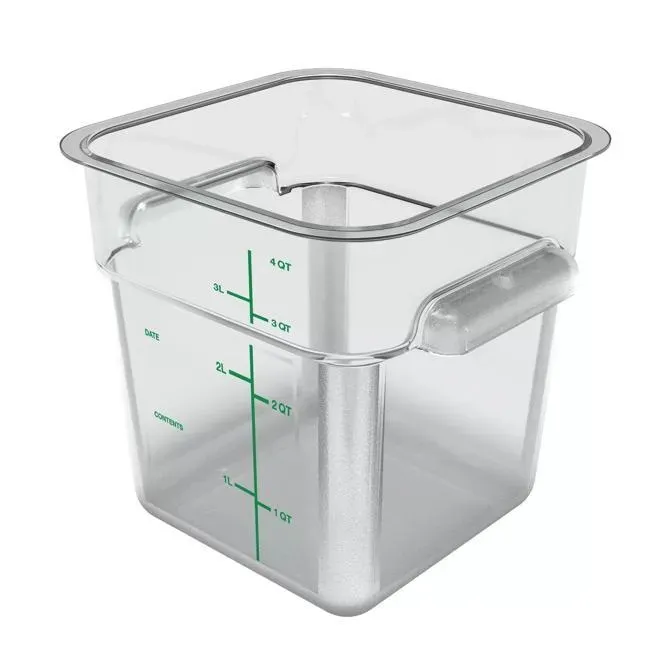
2. Best Value (The Contender): Carlisle Squares
- Best For: High volume operations trying to save 15%.
- Why It Wins: They are virtually identical to Cambro in durability and shape. The lids are tight.
- The Catch: Lids are usually not interchangeable with Cambro. Pick one brand and stick to it, or you will enter “Lid Hell” during prep.
3. Best for Dry Goods (Bulk): Vigor Polypropylene
- Best For: Flour, Sugar, Rice, Dry Pasta.
- Why It Wins: You don’t need crystal clarity for a bag of flour. These are significantly cheaper than Polycarbonate. They are BPA-free and chemical resistant.
- Strategy: Use these for the pantry, save the expensive Cambros for the walk-in.
4. Best Accessory: FIFO Can Racks
- Why You Need It: “First In, First Out” is the golden rule.
- The Problem: Cooks grab the new can from the front. The old can in the back expires.
- The Fix: A gravity-fed can rack forces cooks to take the oldest can first. It saves roughly $500/year in spoiled tomato sauce.
Frequently Asked Questions (FAQ)
Q: Why shouldn’t I use round storage containers? A: Round containers waste roughly 33% of your shelf space because they don’t tessellate (fit together). Square containers maximize density in small walk-ins.
Q: What is the difference between Polycarbonate and Polypropylene? A: Polycarbonate (such as Cambro CamSquare) is crystal clear and virtually unbreakable. Polypropylene is translucent (hazy), cheaper, and chemical resistant but harder to see through.
Q: Can I re-use mayonnaise or pickle buckets? A: No. It is a health code violation. Single-use bulk containers are not rated for re-use because the soft plastic scratches easily, trapping bacteria, and they hold onto odors.
Final Summary
If you walk into a Michelin star kitchen, you will see Cambro CamSquares. If you walk into a smart kitchen, you will see a mix of Cambro for prep and Vigor for dry storage. Just label everything.