“Chef, it’s just a little extra cheese. The customer loves it!” No. If you put 0.5 oz of extra cheese on every pizza, and you sell 1,000 pizzas a week…
- 0.5 oz x 1,000 = 500 oz = 31 lbs of Mozzarella.
- 31 lbs x $3.50/lb = $108 per week.
- $5,600 per year.
You just gave away a used Honda Civic in free cheese. A Portion Scale costs $80. It stops the bleeding instantly. In this guide, I will explain the difference between Baking Scales, Receiving Scales, and the law regarding NTEP.
1. NTEP: Legal for Trade (The Law)
This is the most critical compliance issue. NTEP (National Type Evaluation Program) certification means the government has verified the scale’s accuracy.
The Rule:
- If you sell a product by weight directly to the customer (e.g., Deli Meat, Frozen Yogurt, Coffee Beans, Lobster), you MUST use an NTEP Certified scale.
- If you use the scale internally for portioning (e.g., weighing dough for a pizza), you DO NOT need NTEP.
The Fine: If a Weights & Measures inspector walks in and catches you selling brisket by the pound on a generic kitchen scale, they will confiscate the scale and fine you $1,000.
2. Types of Scales
Portion Control Scales (The Money Saver)
- Capacity: Low (2lb - 10lb).
- Precision: High (0.1 oz).
- Use: Line cooks weighing hamburger patties, cheese, fries.
- ROI: Massive. Buy one for every station.
Receiving Scales (The Auditor)
- Capacity: High (150lb - 400lb).
- Platform: Large, floor level.
- Use: Verifying deliveries.
- Scenario: You ordered 50 lbs of Swordfish. The driver hands you a box. You weigh it. It’s 45 lbs.
- Result: You demand a credit for 5 lbs ($100). The scale just paid for itself.
Smart Scales (POS Integrated)
- The Future (2026): Scales that talk to your Point of Sale (POS).
- Toast / Square Compatibility: Look for scales like the Brecknell 6710U.
- Workflow: You put the Frozen Yogurt on the scale -> The weight appears on the iPad -> The price is auto-calculated. No manual entry errors.
Baking Scales (The Chemist)
- Precision: Ultra-High (0.1 gram).
- Use: Weighing yeast, salt, saffron.
- Baker’s Percentage: Baking is chemistry.
- The Formula: Flour is always 100%. Water, Salt, and Yeast are percentages of the flour weight.
- Example: 1000g Flour. 75% Water = 750g.
- Why: If you want to make 50 baguettes instead of 10, you just multiply the flour. The ratios stay perfect. Scale is mandatory.
3. Tech Specs: Capacity vs. Readability
You cannot have it all.
- Capacity: The maximum weight.
- Readability: The smallest increment.
The Trade-Off:
- A 400lb scale usually has 0.5lb readability. (You can’t weigh 5g of yeast on it).
- A 5lb scale has 0.002lb readability.
- Solution: You need at least two scales in your kitchen. Do not try to weigh a whole pig on a spice scale.
4. Durability: IP65 Waterproofing
“Chef, I spilled milk on the scale and now the screen is flashing 8888.”
Kitchens are wet. You need a scale with an IP (Ingress Protection) rating.
- IP65: Dust tight + Protected against water jets (Washdown safe).
- The Design: Look for “Sealed Electronics” or “Washdown Ready.”
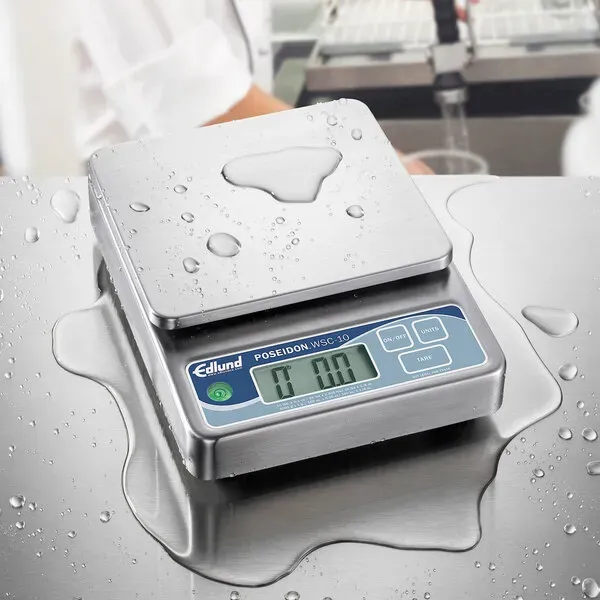
- Brands: Edlund is famous for their waterproof Poseidon series. You can dunk it in a sink.
5. Calibration: Gravity Zones
Did you know gravity is different in Miami vs. Denver? Because the Earth is not a perfect sphere, a 10lb weight weighs slightly less at high altitudes.
- Factory Calibration: Good enough for kitchen prep.
- NTEP Calibration: Must be calibrated on site by a certified technician to account for local gravity.
- The Geography: Scaling in Miami (Sea Level) vs Denver (Mile High) requires different calibration. A 10lb weight actually weighs less in Denver due to altitude and distance from the Earth’s center.
- The Calibration Weight: Buy a Test Weight (e.g., 1kg). Every Monday, put it on the scale. If it reads 995g, recalibrate.
Top 3 Commercial Scale Recommendations
If you need to stop losing money today, these are the three specific models I trust.
1. Best Overall (Waterproof): Edlund Poseidon WSC-10
- Best For: Heavy-duty kitchen prep, messy stations (pizza, proteins).
- Why It Wins: It is IP65 rated and fully submersible. You can dump a continuous stream of tomato sauce on it, blast it with a sprayer in the dish pit, and it still works.
- The ROI: It costs more upfront (~$180), but you won’t replace it every 3 months like a cheap plastic scale.
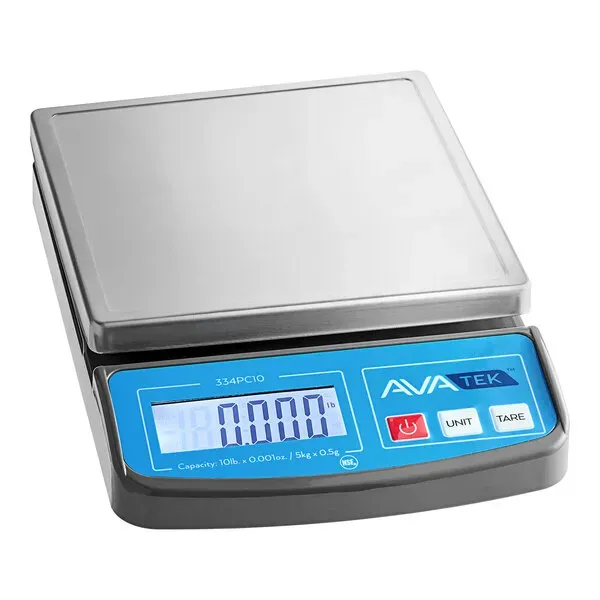
2. Best Value (Line Prep): AvaWeigh PCS10
- Best For: Line cooks, portioning fries/cheese, low-risk areas.
- Why It Wins: At ~$40, it is disposable. It has a large display and is easy to wipe down.
- Strategy: Buy a 6-pack. Put one on every station. When one inevitably gets melted on the flat top, you grab another.
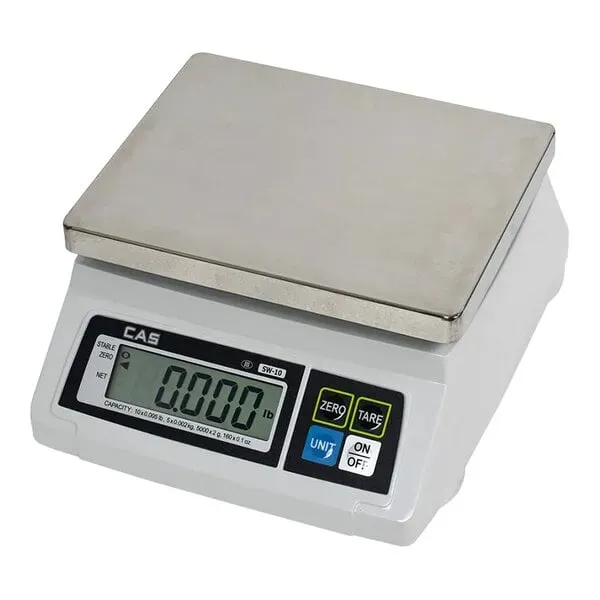
3. Best for Deli/Retail (NTEP): CAS SW-20
- Best For: Selling by weight (Deli, Coffee, Froyo).
- Why It Wins: It is the industry standard for “Legal for Trade” compliance. It has a dual display (one for you, one on the back for the customer), building instant trust.
- Note: Keep the certification sticker visible for the inspector.
Frequently Asked Questions (FAQ)
Q: What does NTEP certified mean? A: NTEP (National Type Evaluation Program) means the scale is “Legal for Trade.” You MUST use an NTEP scale if you sell food by weight directly to a customer (e.g., Deli meat, Coffee beans).
Q: Why is my scale showing “8888” or error codes? A: This usually means water damage. Unless your scale is IP65 Rated (Waterproof), moisture has likely shorted the motherboard.
Q: How often do I need to calibrate my kitchen scale? A: Weekly. Use a known “Test Weight” (e.g., 1kg). Gravity varies by location (Denver vs. Miami), so “factory calibration” is rarely perfect for your specific zip code.
Final Summary
Scale your ingredients, scale your profits. Eye-balling is strictly for amateurs. Start with the AvaWeigh for your line cooks and see your food cost drop by 2% next week.