A sharp knife is a safe knife. A dull knife slips. It hacks. It bruises the herbs (making the basil turn black). But in a commercial kitchen, a knife is also a Contamination Vector. If you cut raw chicken and then cut lettuce with the same knife, you just killed a customer.
In this guide, I will explain the Rockwell Hardness Scale, why “Stamped” knives are actually fine for line cooks, and how to set up a Knife Exchange Service.
1. Manufacturing: Forged vs. Stamped
Forged (The Heavyweight)
- Process: A single bar of red-hot steel is hammered into shape.
- Anatomy: It has a Bolster (thick metal junction) between the blade and handle.
- Balance: The weight is centered. It feels like an extension of the hand.
- Durability: The blade is thick.
- Cost: Expensive ($80 - $150).
- Who Needs It: The Executive Chef.
Stamped (The Lightweight)
- Process: Punched out of a sheet of steel like a cookie cutter. Then heat treated.
- Anatomy: No bolster.
- Weight: Light. Less fatigue after chopping 50lbs of onions.
- Cost: Cheap ($15 - $30).
- Who Needs It: The Line Cook. Why? because when they drop it tip-first on the tile floor, it hurts less (financially).
2. Metallurgy: The Rockwell Scale (HRC)
Steel hardness is measured in HRC. This determines “Edge Retention” vs. “Brittleness.”
The German School (HRC 56-58) - Wusthof, Mercer
-
Steel: Softer.
-
Edge: Rolls over easily. Needs frequent honing.
-
Steel Code: X50CrMoV15 (0.5% Carbon, 15% Chrome, Vanadium).
-
Chemistry: The 15% Chromium makes it virtually rust-proof. The Vanadium adds toughness so it doesn’t chip.
-
Pro: Tough. If you hit a bone, the edge dents (rolls). It does not chip. Easy to sharpen back.
-
Angle: Typically sharpened to 20 degrees.
-
Verdict: The Workhorse.
The Japanese School (HRC 60-62) - Shun, Miyabi
- Steel: Very Hard.
- Edge: Holds an edge for weeks. Laser sharp (15 degree angle).
- Con: Brittle. If you hit a bone or drop it, the blade CHIPS like glass.
- Verdict: Only for precision slicing (Sushi). Never for breaking down chickens.
3. HACCP Color Coding: Safety First
Cross-contamination is the #1 health violation. The FDA HACCP Guidelines emphasize color-coding to separate raw and cooked foods. You cannot trust a busy cook to wash a knife perfectly between tasks. Solution: Manufacturer-coded handles.
- Red: Raw Meat (Beef/Pork).
- Yellow: Raw Poultry (Chicken).
- Blue: Raw Seafood.
- Green: Produce (Veg/Fruit).
- White: Dairy / Bakery / Cooked Food.
- Brown: Cooked Meat.
- Purple: Allergens (Gluten Free).
The Rule: If a Health Inspector sees a Red Knife on a Green Cutting Board… automatic violation.
4. Maintenance: Honing vs. Sharpening
These are NOT the same thing.
Honing (The Rod)
- Tool: The “Steel” (grooved metal rod).
- Physics: It Re-Aligns the edge.
- Microscope View: As you cut, the microscopic teeth of the blade bend over (like messy hair). Honing combs the hair back straight.
- Frequency: Every time you pick up the knife.
Sharpening (The Grinder)
- Tool: Whetstone (Slow) or Commercial Machine (Fast).
- Angle:
- 20 Degree: Standard Western. Durable. Good for chopping through chicken joints.
- 15 Degree: Asian / Modern Hybrid. Laser sharp, but brittle.
- Machine Pick:
- Chef’s Choice 15XV ($150): Great for small kitchens. Converts 20° knives to 15°.
- Tormek T-2 Pro ($700): The heavy-duty commercial standard. Uses a diamond wheel that doesn’t overheat the steel. 1 minute per knife.
5. The Knife Exchange Service vs. Owning
Should you buy knives for your crew? No. They will steal them or destroy them.
The Service Model (Cozzini / PostKnife):
- Contract: The company drops off 20 sharp knives every Monday.
- Exchange: They take the 20 dull knives away to be ground by robots.
- Cost: ~$3 per knife per week.
- Pros: You always have sharp knives. No maintenance.
- Cons: The knives are cheap stamped steel. They are ground aggressively (shorter life).
- Verdict: Mandatory for Prep Kitchens and High Volume chains.
Top 3 Commercial Knife Recommendations
Knives are highly personal, but these are the industry standards for ROI and performance.
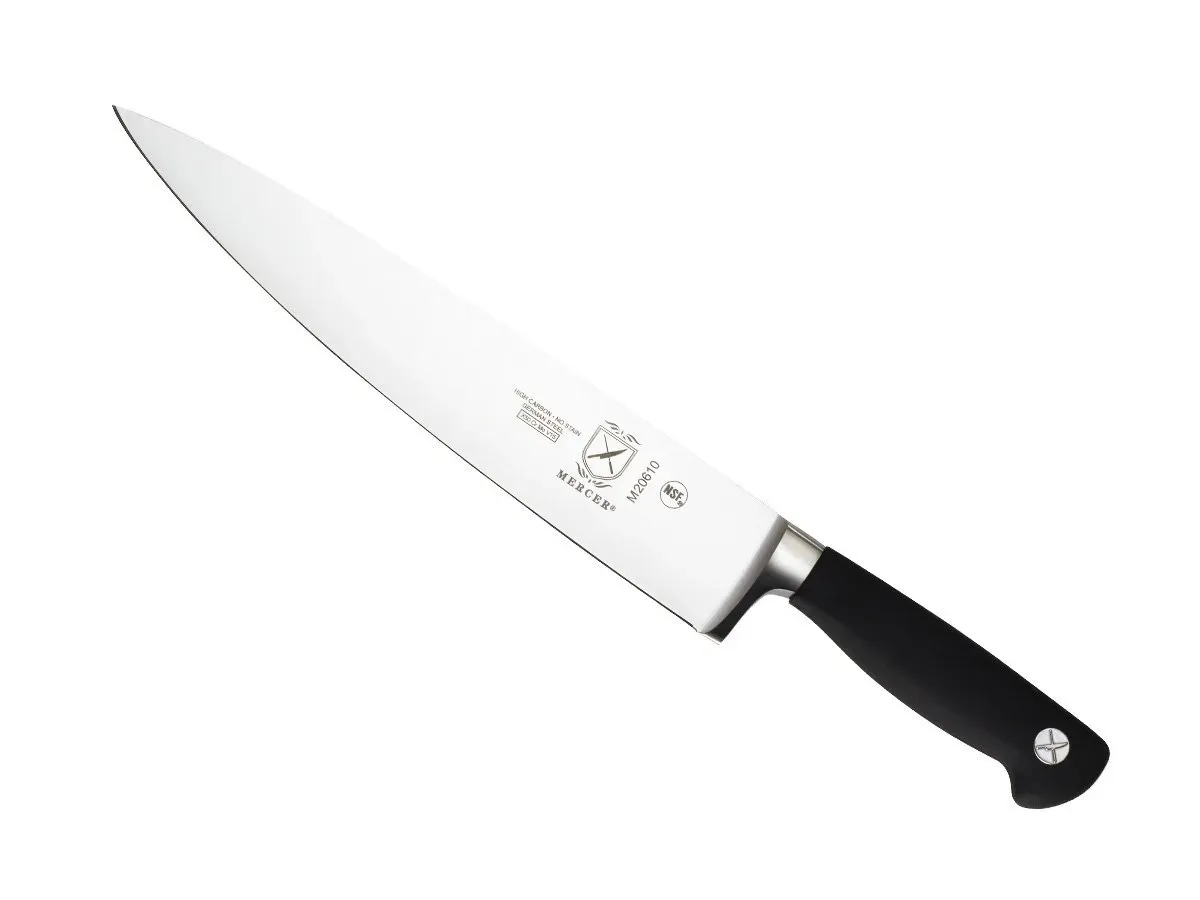
1. Best Overall (Line Cook): Mercer Culinary Genesis (8-inch)
- Best For: All-day chopping, prep, line work.
- Why It Wins: It is Forged (durable) but affordable. The Santoprene handle is grippy even when your hands are covered in chicken grease. NSF certified (no bacteria traps).
- The Steel: German Steel (X50CrMoV15). Easy to sharpen, holds an edge well.
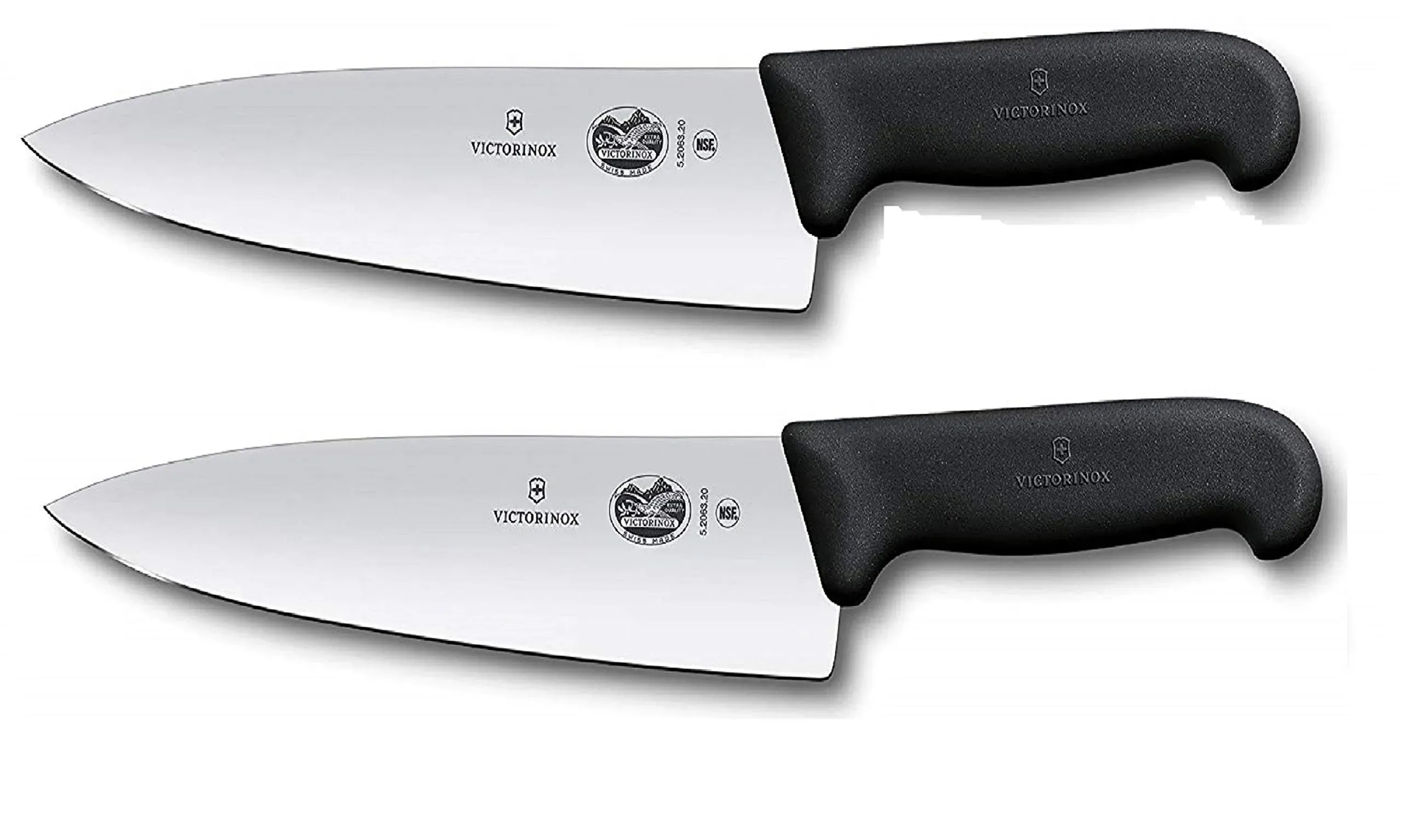
2. Best Budget (The Beater): Victorinox Fibrox Pro
- Best For: High volume prep, communal kitchen knives.
- Why It Wins: Use by butchers everywhere. It is Stamped (lightweight), razor sharp out of the box, and the handle is virtually indestructible. If you drop it, you don’t cry.
- Winning Feature: The non-slip handle texture is the best in the business.
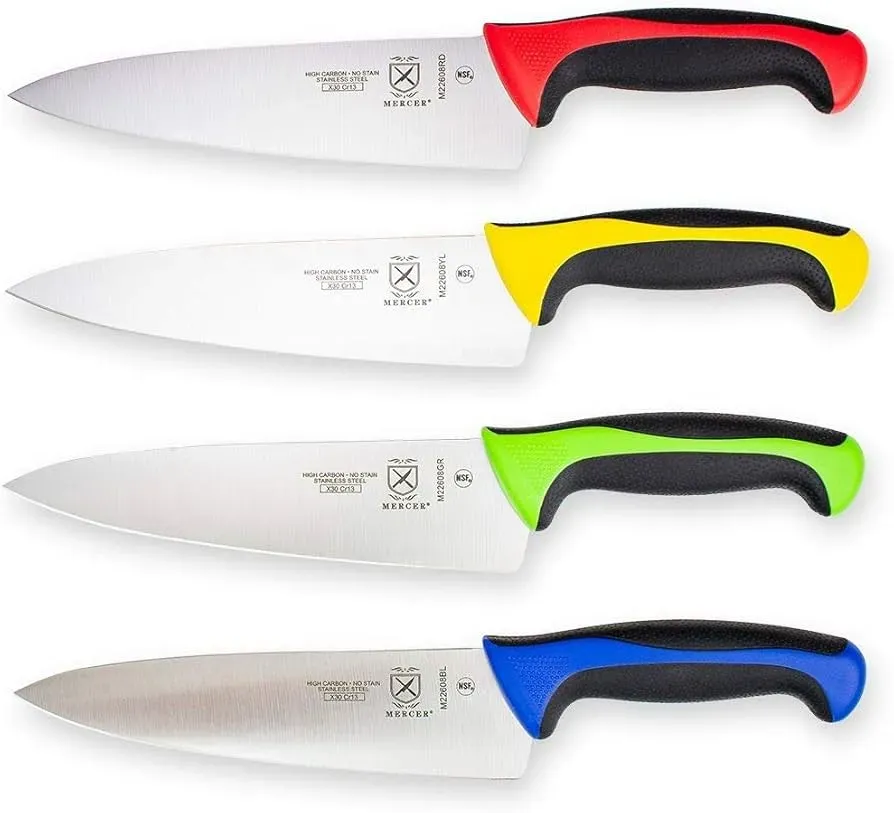
3. Best Color-Coded (HACCP): Mercer Millennia Series
- Best For: Preventing cross-contamination.
- Why It Wins: You can buy the exact same knife with Red (Meat), Yellow (Poultry), and White (Dairy) handles.
- Rule: Buy a full set. If I see you cutting lettuce with the Red knife, you’re fired.
Frequently Asked Questions (FAQ)
Q: What is the difference between Forged and Stamped knives? A: Forged knives are made from a single bar of steel with a bolster (thick heavy handle/blade junction). Stamped knives are punched from a sheet (lighter, no bolster).
Q: Why do I need color-coded knives? A: To prevent Cross-Contamination. Standard HACCP colors are: Red (Raw Meat), Yellow (Chicken), Blue (Seafood), Green (Produce), White (Cooked/Dairy), and Purple (Allergens).
Q: Is Honing the same as Sharpening? A: No. Honing (Rod) realigns the existing edge (like combing hair). Sharpening (Stone/Grinder) removes metal to create a new edge.
Final Summary
Do not bring your $300 Japanese knife to work unless you are the Executive Chef and it never leaves your sight. For the line, Mercer Genesis is the king of value.