A line cook stands for 10 to 12 hours a day on concrete. Concrete is unforgiving. It sends shockwaves up the spine with every step. If you don’t provide mats, two things happen:
- Production Drops: Your cooks get slower at hour 9 because their lower back is screaming.
- The Resignation: They quit. They find a kitchen that cares about their health.
Mats are not a luxury. They are Personal Protective Equipment (PPE). But buying the WRONG mat is actually more dangerous than having no mat at all. A dissolving, curling mat is a tripping hazard waiting to dump a pot of boiling stock on someone’s legs.
In this guide, I will explain the Nitrile Chemistry, the color codes, and the economics of buying the right mat the first time.
Red vs. Black: The Grease Test
This is the only rule you need to memorize. If you work in a commercial kitchen, you are surrounded by animal fats and vegetable oils. These oils attack rubber.
1. The Red Mat (Grease Proof)
- Material: Nitrile Rubber (Synthetic).
- Chemistry: Nitrile is the same material used in oil-resistant O-rings in car engines. It effectively repels oil molecules.
- Behavior: You can drop fryer oil on it, leave it overnight, and it stays flat. It does not absorb the grease.
- Where to use: The Hot Line. (Fryers, Flat Tops, Sauté Stations). anywhere grease hits the floor.
- Price: Expensive (~$60 for 3x5).
2. The Black Mat (Grease Resistant / General Purpose)
- Material: Natural Rubber.
- Chemistry: Natural rubber is porous. If you expose it to hot oil, it drinks it up like a sponge.
- The Failure Mode: The mat swells. The edges curl up like a potato chip. The rubber becomes soft and gummy.
- The Danger: Your cook trips on the curled edge while carrying a knife.
- Where to use: Dish Pit (if it’s just water), Prep Tables (Vegetable prep only), Bar Areas.
- Price: Cheap (~$30 for 3x5).
Chef’s Verdict: If there is even a 1% chance of grease hitting the floor, BUY RED. The savings on the Black mat evaporate the moment you have to replace it 2 months later because it dissolved.
Drainage vs. Solid: The Wet Test
1. Drainage Mats (Holes)
These look like Swiss cheese. They have large circular or hexagonal holes.
- Physics: Liquids (water, spilled soup, cleaning chemicals) pass through the holes to the floor below.
- Benefit: The cook stands on the raised rubber ridges, keeping their feet dry and maintaining traction. The fluid is not trapped under their shoe.
- Best For: Dish Rooms, Bar Wells, Cook Lines. Anywhere liquids are spilled.
2. Solid Mats (No Holes)
- Physics: A solid slab of foam or rubber.
- Benefit: Easier to sweep. Stuff doesn’t get trapped underneath.
- Risk: If you spill water on it, it pools on top. It becomes a slip-and-slide.
- Best For: Host Stands, Cashier Stations, Dry Prep Areas. Anywhere the floor is guaranteed to stay dry.
Beveled Edges: The Trip Hazard
Cheap mats have a “Straight Edge” (a 90-degree cliff). Good mats (like Cactus Mat or Notrax) have a Beveled Edge (a ramp).
- Why it matters:
- Carts: You can roll a speed rack or utility cart OVER a beveled mat. If you try to roll a cart over a straight edge, the cart stops, and the food flies off.
- Tripping: Lazy feet slide up the ramp instead of catching the edge.
ROI Analysis: The “Slip and Fall” Math
Let’s look at the cost of being cheap.
Scenario: You buy 3 cheap Black Mats for the Fryer Line.
- Cost: $90 ($30 each).
- Timeline: Month 2. They curl.
- The Incident: Cook trips carrying a basket of fries. Worker’s Comp Claim.
- The Cost:
- Medical: $5,000+
- Lost Labor: 2 weeks.
- Insurance Premium Hike: +15%.
- Replacement Mats: Now you have to buy the Red ones anyway ($180).
Total Cost of “Saving Money”: $6,000+. Just buy the Red Mats on Day 1.
The Lawsuit Defense: NFSI Certification
In 2026, insurance companies are denying claims if you use “Generic” mats.
- The Standard: Look for the NFSI (National Floor Safety Institute) logo.
- The Rating: “High Traction” (Greater than 0.60 TCOF).
- The Benefit: If a cook slips on an NFSI mat, you have a legal defense: “We used certified safety equipment.” If they slip on a cheap mat, you are negligent.
Cleaning Protocol: How to Kill a Mat
NEVER put floor mats in the dishwasher. I have seen rookie KPs layer mats inside the conveyor dishwasher.
- The Disaster: The 180°F heat melts the rubber. The mat turns into a heavy, sticky goo. It falls apart and clogs the dishwasher drain pump.
- The Repair Bill: $500 for a plumber to snake the drain. $200 for a new mat.
The Correct Cleaning Method:
- Transport: Carry mats to the back dock or mop sink.
- Deck Brush: Lay them flat on the concrete.
- Chemical: Splash hot soapy water (Degreaser) on them. Scrub vigorously with a stiff deck brush.
- Hose: Spray down with high pressure.
- Hang: Hang them on a mat rack or over a railing to drip dry.
- The Floor: While the mats are drying, mop the floor underneath where they sit.
Brands to Trust
- Cactus Mat: The industry heavyweight. Their “VIP” Red Mat is the gold standard.
- Notrax: Excellent ergonomic science.
- Wearwell: Industrial grade.
Top Commercial Kitchen Mat Recommendations
Save your back. Save your knees.
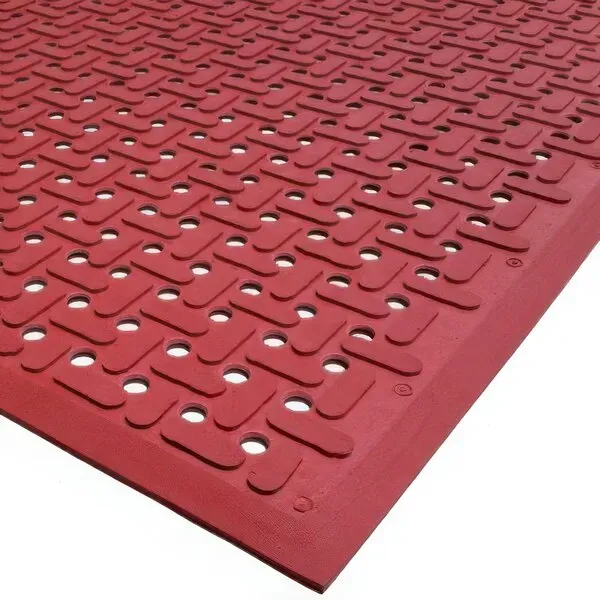
1. Best Overall (The Fat-Proof King): Cactus Mat VIP Red
- Best For: The Fryer Line, Sauté Station.
- Why It Wins: Made of Nitrile Rubber. It eats grease for breakfast. It will not curl up.
- Durability: 5+ years even in abusive kitchens.
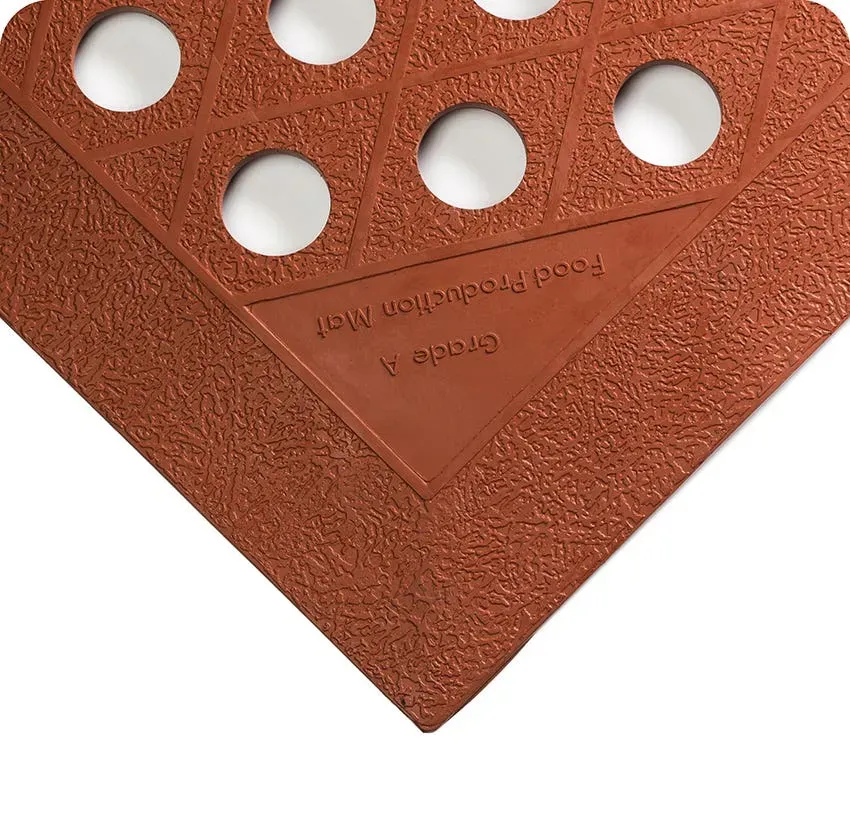
2. Best Hygiene (The Clean Freak): Wearwell Grade A
- Best For: Food Processing, Butcher Rooms.
- Why It Wins: Designed with “portholes” and built-in handles for easier lifting and cleaning. 100% Anti-Microbial.
- Design: No places for bacteria to hide.
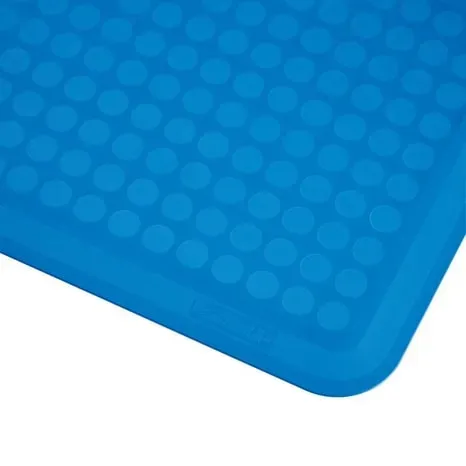
3. Best Ergonomics (The Back Saver): Notrax Sani-Flex
- Best For: Prep Tables, Dishwashers.
- Why It Wins: Super dense cushioning. It feels like standing on a cloud compared to cheap mats.
- Grip: Excellent non-slip properties on wet tile.
Frequently Asked Questions (FAQ)
Q: What is the difference between Red and Black kitchen mats? A: Red Mats are made of Nitrile Rubber and are Grease-Proof (for Fryer lines). Black Mats are natural rubber and will dissolve/curl if exposed to grease (General purpose only).
Q: Why is my kitchen mat curling up? A: You likely used a general-purpose Black mat in a grease area. The oil has soaked into the rubber, causing it to swell and warp.
Q: What is NFSI certification? A: The National Floor Safety Institute (NFSI) certifies mats as “High Traction.” Using certified mats can protect you in slip-and-fall lawsuits.
Final Summary
If you are working with Hot Oil, buy Cactus Mat (Red). If you need Comfort, buy Notrax.