If the Range is the engine of the kitchen, the Walk-In Cooler is the fuel tank. It holds $10,000 worth of inventory. If it fails on a Saturday night, you don’t just lose money. You lose your reputation.
Buying aA Walk-In Cooler is not a refrigerator. It is a building. It is a structural addition to your property. And if you buy a cheap one, it will rot.
Since the Dept of Energy (DOE) Regulations updated in 2020, insulation requirements have become stricter. You cannot just buy used panels from Craigslist anymore.
This guide covers R-Values, flooring, and why outdoor installations require a “Winter Kit.”
1. Floors: With Floor vs. Floorless
This is the first question the salesman will ask.
Floorless (The Concrete Slab)
- Design: The walls screw directly into the concrete floor of your building.
- Insulation: Zero. The concrete is the floor.
- The Trap: Concrete is a heat sink. It sucks the cold out of the room.
- Requirement: Only legal for Coolers (35°F).
- Pro: No ramp! You can roll carts right in.
- Con: High energy bills. Condensation on the humidity ring.
With Floor (The Insulated Box)
- Design: Comes with a 4-inch insulated metal floor.
- Insulation: Perfect seal. Very efficient.
- Requirement: MANDATORY for Freezers. If you put a freezer on bare concrete, the ground freezes, expands (Permafrost), and cracks your building’s foundation. (Heaving).
- The Ramp: The floor is 4 inches high. You need a ramp.
- The Annoyance: Rolling a soup cart up a steep ramp is dangerous. Someone will spill.
2. Refrigeration System: Remote vs. Saddle Mount
Where does the heat go?
Saddle Mount / Self-Contained (The Backpack)
- Design: The compressor hangs on the side of the box (like a backpack).
- Pros: Cheap. Easy to install (plug and play).
- Cons:
- Heat: It dumps 20,000 BTUs of hot air into your kitchen. In July, your kitchen becomes Hell.
- Noise: It sounds like a jet engine.
- Verdict: Only for small boxes in a large, ventilated warehouse.
Remote Refrigeration (The Professional Choice)
- Design: The compressor is on the roof of the building (outside).
- Pros:
- Heat: All heat is dumped outside. Kitchen stays cool.
- Noise: Silent kitchen.
- Efficiency: Compressors run better in cold winter air.
- Cons: Expensive installation. You need a copper line set run through the ceiling and an electrician to wire the roof.
- Verdict: Mandatory for any serious restaurant.
Critical: Outdoor Installation
If you put the box outside (to save kitchen space), you need a “Winter Package”.
- Membrane Roof: A rubber rubber “hat” that sheds rain. Standard panels leak.
- Winter Controls: Heated crankcase for the compressor so oil doesn’t freeze at -10°F.
- Door Heater: A heated wire around the door frame so it doesn’t freeze shut.
3. Panels & Insulation: The EISA Law
In 2007, the Energy Independence and Security Act (EISA) changed the rules.
- R-Value: Panels must meet minimum insulation standards (R-25 for Coolers, R-32 for Freezers).
- Foam:
- Polyurethane: The gold standard. Foamed in place. Strong. High R-value per inch.
- Polystyrene (Styrofoam): Cheaper. Needs to be thicker to match the R-value.
- Speed-Lok (Bally) vs Posi-Loc (Kolpak): Proprietary cam-locks that pull panels together. Essential for a tight seal.
EISA 2026 Compliance Table: If a used box doesn’t meet these R-Values, it is illegal to install in some states.
| Component | Minimum R-Value |
|---|---|
| Cooler Walls/Ceiling | R-25 |
| Freezer Walls/Ceiling | R-32 |
| Freezer Floor | R-28 |
4. The Strip Curtain: The $100 Energy Saver
Every time you open the door, cold air (heavy) pours out the bottom like a waterfall. Hot air (light) rushes in the top. A Strip Curtain (PVC Plastic Strips) creates a barrier.
- The Math: It cuts air infiltration by 75%.
- The ROI: It saves roughly $500/year in electricity.
- The Complaint: “Chef, it hits me in the face.”
- The Response: “Get over it. Or pay the electric bill.”
5. Lighting: The Vapor Proof Bulb
Walk-ins are wet. You cannot use a regular light fixture. It will short out. You need Vapor Proof LED Fixtures (The “Jelly Jar” style).
- Temperature: Standard fluorescent tubes flicker and die in the cold (especially freezers).
- LED: Loves the cold. Turns on instantly at -10°F.
Top 3 Commercial Walk-In Cooler Recommendations
This is a 20-year investment. Buy quality panels.
1. Best Durability (The Legend): Bally Refrigerated Boxes
- Best For: High-Volume Restaurants, Outdoor Installations.
- Why It Wins: Bally panels have used the same “Speed-Lok” mechanism for 90 years. I have seen 40-year-old Bally boxes that seal perfectly.
- Insulation: Poured-in-place urethane that doesn’t shrink over time.
2. Best Standard Unit (The Quick Ship): Nor-Lake Kold Locker
- Best For: Standard spaces (6x6, 8x10).
- Why It Wins: If you need a box tomorrow, Nor-Lake stocks thousands of standard sizes. The “Kold Locker” series is the industry standard for fast lead times.
- Value: Great balance of price and R-value efficiency.
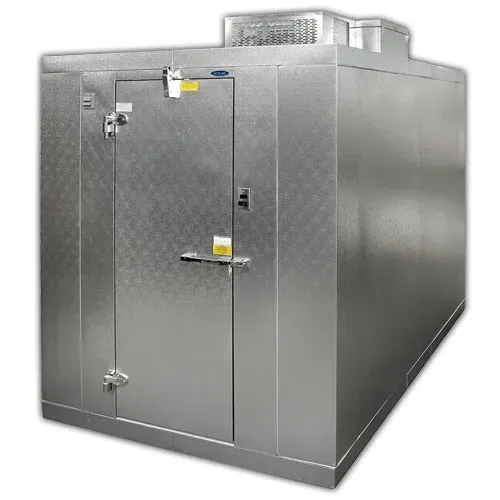
3. Best Custom (The Fabricator): Kolpak
- Best For: Weirdly shaped rooms, hotels with support columns.
- Why It Wins: Kolpak will build a box around a structural column. Their engineering team is the best at custom shapes.
- Performance: Uses high-efficiency “120 Series” refrigeration systems.
Frequently Asked Questions (FAQ)
Q: Do I need an insulated floor in my Walk-In? A: For Coolers, it is optional (you can use the concrete slab). For Freezers, it is MANDATORY. Without an insulated floor, the ground underneath will freeze and heave (crack) your building’s foundation.
Q: What is a “Remote” refrigeration system? A: The noisy, hot compressor is put on the Roof (outside). This keeps your kitchen quiet and cool. It is much better than a “Saddle Mount” which dumps heat back into the kitchen.
Q: Why is there ice on my walk-in door? A: Air leak. Warm air is getting in. Check the door gasket and the “Door Heater Wire.” If the wire is dead, condensation freezes the door shut.
Final Summary
If you need Fast, buy Nor-Lake. If you need Custom, buy Kolpak. If you want it to last Forever, buy Bally.
Chef Marco’s Rule: “Check the ‘Inside Release’ knob on the door. Every week. Test it. Walk inside, close the door, and try to push the glow-in-the-dark knob. If it is broken, FIX IT TODAY. Getting locked in a freezer at -10°F is not a joke. It is how people die.”