When you open a restaurant, a nice salesperson in a branded polo shirt walks in. He looks at your dish machine. He touches your sink. He says, “I’ll give you these soap dispensers for FREE! I’ll even come install them! All you have to do is buy our chemicals.”
It is a trap.
Companies like Ecolab, Diversey, and Auto-Chlor charge a massive premium for their “Service”. You are not paying for the soap. You are paying for the rep’s commission, the branded truck, the “free” dispensers, and their corporate overhead. If you are willing to pour your own soap, you can save thousands of dollars a year by switching to Noble Chemical (WebstaurantStore’s house brand) or other generics.
In this guide, I will break down the chemistry, the math, and the safety protocols you need to fire your chemical rep and keep the money.
The “Active Ingredient” Secret
Here is the truth the reps don’t want you to know: Chemistry is Chemistry. The FDA and EPA regulate sanitizers.
- Bleach is Sodium Hypochlorite.
- Quat Sanitizer is n-Alkyl Dimethyl Benzyl Ammonium Chloride.
Ecolab didn’t invent bleach. They just put it in a proprietary bottle that only fits their proprietary dispenser.
The Comparison Table
| Product Type | Brand Name (Expensive) | Generic Name (Noble/Regal) | Active Ingredient |
|---|---|---|---|
| Degreaser | Greasecutter Plus | Strike | Potassium Hydroxide |
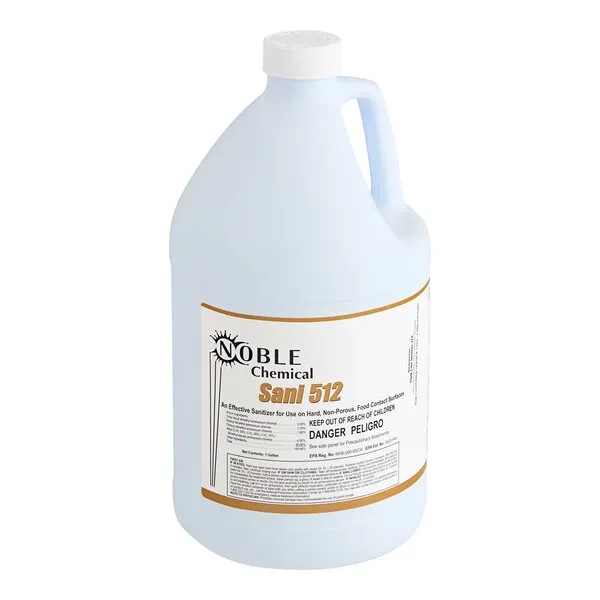
| Sanitizer | Oasis 146 | Sani-512 | Quaternary Ammonium |
| Dish Soap | Pantastic | Sunbright | Surfactants / Citrus |
| Delimer | Lime-A-Way | Lime-B-Gone | Phosphoric Acid |
The Verdict: Assuming the dilution ratio is correct, Sani-512 kills the exact same bacteria as Oasis 146. The bacteria do not know how much you paid for the bottle.
The Hidden Danger: “Quat Binding” (Why you failed inspection)
- The Science: Cotton towels have a negative charge. Quat sanitizer has a positive charge.
- The Result: If you soak a cotton towel in a sanitizer bucket, the cotton Absorbs 50% of the active chemical in 10 minutes. The water tests “zero” PPM, and you fail the health inspection.
- The Fix: Use Microfiber (Synthetic) or disposables. They do not bind the Quat.
Dilution Math: The Cost per Gallon
The trick they use is “Concentrate.” They sell you a bag of concentrate for $80 and say “It makes 100 gallons!” Let’s check the math on Generics.
Example: Floor Cleaner
- Generic Concentrate (Noble): $25 for 2.5 Gallons.
- Dilution: 1 oz per gallon of water.
- Yield: 2.5 Gallons = 320 oz.
- Total Output: 320 mop buckets.
- Cost per Bucket: $0.07.
Example: Ready-To-Use (RTU) Sprays Never buy “Ready to Use” sprays for a commercial kitchen. A bottle of Windex costs $4. A bottle of water with a drop of Noble blue concentrate costs $0.02. You are paying for shipping water. Buy the concentrate and a reusable spray bottle.
The “Dispenser” Trap (and Solution)
“But Marco, my staff is stupid. If I don’t use the Ecolab measured system, they will pour the whole jug in the sink!”
This is a valid concern. Glug-Glug pouring wastes money. The Solution:
1. Wall Sink Dispensers ($150 One-Time)
You can buy your own chemical dispenser (like Dema or Knight).
- You hook it to the water line.
- You screw in the generic bottle cap.
- It mixes automatically.
- ROI: It pays for itself in 2 months of soap savings.
2. The Pump Method ($5)
If you are broke, buy a 1oz Pump for the gallon jug.
- Rule: “One Pump per Sink.”
- Write it on the wall with Sharpie.
- If the water is blue, it’s good.
Dish Machines: Low Temp vs. High Temp
This is the only place where chemistry gets tricky.
High Temp Machines (180°F Rinse)
- Sanitization: Uses hot water.
- Chemicals: Detergent (Wash) + Rinse Aid (Drying).
- Generic Friendly? YES. You can use any heavy duty detergent.
Low Temp Machines (120°F Rinse)
- Sanitization: Uses Chlorine (Bleach).
- Chemicals: Detergent + Rinse Aid + Sanitizer.
- The Risk: If your bleach line runs empty, you are serving food on dirty plates.
- Generic Friendly? YES, but you must check the bleach bucket daily.
Note on Leasing: If you lease your dish machine from Ecolab, your contract likely requires you to buy their chemicals. Read the fine print. To escape, you have to buy your own machine (CMA or Jackson).
Floor Care: The Enzyme Secret
Grease is not just on the surface. It is in the Grout. If your kitchen smells like old oil even after mopping, you have grease trapped in the porous grout lines.
- Bleach: Does NOT remove grease. It just whitens it.
- Degreaser: Removes surface grease, but can be slippery.
- Enzyme Cleaners (The Secret Weapon):
- These contain live bacteria (Enzymes).
- You mop it on at night and leave it. DO NOT RINSE.
- Overnight, the bacteria “eat” the grease in the grout.
- Product: Noble Chemical E-Grit or Novo.
Safety: OSHA and SDS Sheets
If you fire the rep, YOU are now the Safety Officer. OSHA requires that you have an SDS (Safety Data Sheet) for every chemical in the building.
- The Binder: Buy a yellow “SDS” binder.
- The Printouts: Go to the Webstaurant product page. Click “SDS/Spec Sheet”. Print it.
- The Location: Keep the binder in the office or prep area where everyone can see it.
- The Labels: If you put blue cleaner in a generic spray bottle, you MUST write “Degreaser” on the bottle. An unlabeled bottle is a massive violation.
- **The Death Mix:**But if you mix Bleach with Delimer? You create Chlorine Gas. You evacuate the restaurant. Fire trucks show up.
This guide explains the chemistry of commercial cleaning so you don’t poison your customers or your staff. We will cover the OSHA Hazard Communication Standard requirements and the essential “Red/Green/Blue” bucket system.
Top Commercial Chemical Recommendations
Stop paying for the brand name. Pay for the chemistry.
1. Best Value (The Generic Hero): Noble Chemical Strike & Sani-512
- Best For: 90% of Independent Restaurants.
- Why It Wins: “Strike” is a heavy-duty degreaser that works exactly like the expensive stuff. “Sani-512” is the industry standard Quaternary sanitizer.
- Savings: You will save ~$400/month compared to a leased service.
2. Best Service (The Hands-Off Choice): Ecolab
- Best For: Hotels, High-Turnover Chains.
- Why It Wins: You are paying for the Service Rep. If your dishwasher breaks at 10 PM on a Friday, they (might) come fix it. The chemicals are premium and concentrated.
- Cost: The most expensive option.
3. Best Eco-Friendly (The Green Choice): Diversey (Solenis)
- Best For: Corporate Cafeterias, LEED Certified Buildings.
- Why It Wins: Their “PurEco” line is Green Seal certified. They use “Super Concentrates” to reduce plastic waste.
- ** Innovation:** Their “IntelliDish” system tracks water usage remotely.
Frequently Asked Questions (FAQ)
Q: Can I mix bleach and ammonia? A: NEVER. Mixing bleach and ammonia creates Chloramine Gas, which is deadly. Never mix different cleaning chemicals.
Q: What is “Quat Binding”? A: Cotton towels absorb (bind) the active sanitizer molecules, rendering the solution useless. You should use Microfiber towels or disposable wipes with Quaternary Sanitizers.
Q: Is generic commercial sanitizer as good as the brand name? A: Yes. The active ingredient (Quaternary Ammonium) is chemically identical. As long as you follow the dilution ratio, it kills 99.9% of bacteria just like the expensive brands.
Final Summary
If you want to Save Money, buy Noble Chemical. If you want Full Service, buy Ecolab.