“Chef, the microwave is sparking.”
I hear this at least once a year. Usually, it’s because a frantic line cook put a spoon in there. But more often than I’d like to admit, it’s because the owner tried to save $300 by buying a residential microwave from Target or Walmart.
Let me be perfectly clear: Residential microwaves have no place in a commercial kitchen.
If you are running a professional operation, you need professional gear. I have seen “home” microwaves catch fire, shatter their glass plates, and simply refuse to heat food during a Friday night rush.
“We cook everything fresh.” Liar. Every kitchen has a microwave. It is an essential tool for melting butter, warming soups, and steaming veggies à la minute.
However, a Panasonic Commercial microwave is built to withstand 200 door slams a day. A residential microwave will die in a week.
This guide explains the difference between a $200 “Walmart Special” and a $1,500 Commercial Steamer-Microwave.
The “Golden Rule” of Microwaves
Residential microwaves have a rotating glass plate. Commercial microwaves have a flat floor.
That glass plate? It is the enemy. It is a moving part that will eventually strip its gears. More importantly, it is a fragile piece of glass that will shatter the first time a line cook slams a heavy ceramic bowl onto it during a dinner rush. When that plate breaks, your microwave is dead until you find a replacement part (which takes 3 days).
A commercial microwave uses a Stirrer Fan system hidden in the ceiling or floor to distribute the waves. This allows for a completely flat, ceramic bottom shelf. You can slide pans in and out. You can fit odd-shaped containers. And there is nothing to break.
Deep Dive: Understanding Commercial Wattage
Most chefs ignore wattage until they wonder why their soup takes 3 minutes to heat up. In the commercial world, wattage equals Time and Throughput.
The Three Tiers of Power
1. Light Duty (1000 Watts) - “The Waitress Station”
- Target Usage: < 50 times a day.
- Best For: Warming muffins, melting butter, reheating coffee, softening ice cream.
- The Problem: They are slow. Heating a bowl of soup from 40°F to 165°F takes about 2 to 2.5 minutes.
- Magnetrons: 1 (Bottom or Side fed).
2. Medium Duty (1200 - 1800 Watts) - “The Line Cook’s Helper”
- Target Usage: 50 - 150 times a day.
- Best For: Reheating pre-portioned soups, steaming single servings of broccoli, warming tortillas.
- Speed: That same soup takes about 60-90 seconds.
- Magnetrons: Usually 1, but heavy-duty transformers.
3. Heavy Duty (2100 - 3200 Watts) - “The Sonic Steamer”
- Target Usage: 200+ times a day. This machine never stops.
- Best For: Fast casual chains (Chipotle/Panera style), steaming raw proteins, bulk defrosting.
- Speed: That soup is hot in 35-45 seconds.
- Magnetrons: Two (Dual Magnetron). This is critical. If one breaks, the unit still works at 50% power, so you aren’t dead in the water during service.
The Contenders: Panasonic vs. Sharp
There are other brands (Amana, Solwave), but if you walk into any serious kitchen, you will see one of these two names.
1. Panasonic (The “Pro” Series)
Panasonic is the gold standard. They invented the “Sonic Steamer” category.
- The NE-1054 (The “Workhorse”): This is the 1000W unit you see everywhere. It is legendary. I have seen one that fell off a prep table, dent the floor, and still turn on.
- Pro: No turntable. Bottom energy feed.
- Con: The dial timer can get stripped if you abuse it.
- The Sonic Steamer (2100W+): These are beasts. They use a unique “Inverter Technology” that actually modulates power rather than just pulsing 100% on and off. This means you can gently simmer a sauce without exploding it.
2. Sharp (The “Medium Duty” King)
Sharp dominates the mid-range market. If the Panasonic is a Tank, the Sharp is a Toyota Camry. Reliable, cheaper, and gets the job done.
- R-21 Series (The Classic): This is the competitor to the Panasonic NE-1054.
- Dial vs. Digital: I effectively ban digital keypads in my kitchens for low-volume units. Why?
- The “Wet Finger” Factor: Cooks have wet, greasy hands. Membrane buttons (the flat plastic ones) eventually crack, peel, and fail.
- The Dial: You grab it, you twist it. It works even if you are wearing oven mitts. It works if your hand is covered in flour.
The “Chef’s ROI” Calculator
Owners always balk at the price. “Why spend $1,200 on a microwave when I can get one for $300?”
Let’s do the math on a Panasonic Sonic Steamer (2100W) vs. a Residential Unit (1000W).
Scenario: A busy lunch spot selling 100 bowls of steamed veggies a day.
| Feature | Residential (1000W) | Sonic Steamer (2100W) |
|---|---|---|
| Cook Time (Veggies) | 120 Seconds | 45 Seconds |
| Time Saved Per Dish | 0 | 75 Seconds |
| Time Saved Per Day | 0 | 125 Minutes (2+ Hours!) |
| Labor Cost ($20/hr) | $0 | $40 Saved / Day |
| Annual Savings | $0 | $14,600 / Year |
Verdict: The $1,200 microwave pays for itself in one month of labor savings. Faster throughput equals faster table turnover equals more profit.
Installation & Safety: The “Death Trap”
I once walked into a kitchen takeover and found the microwave mounted on a high shelf, 6 feet off the ground.
This is a lawsuit waiting to happen.
1. The “Eye Level” Rule
Never, ever mount a microwave above the eye level of your shortest cook.
- The Risk: Removing a piping hot bowl of liquid from above your head is dangerous. If it spills, it pours directly onto the cook’s face and chest.
- The Fix: Countertop only, or an under-counter shelf.
2. Electrical Dedicated Circuits
Commercial microwaves draw a LOT of amps.
- 1000W Unit: Draws ~14-16 Amps. It needs a dedicated 20A breaker (NEMA 5-15P or 5-20P).
- 2100W Unit: Draws 20-30 Amps. Requires a NEMA 6-20P (208/240V) plug.
- The Mistake: Plugging it into a power strip. Do not do this. You will melt the strip and start a fire.
3. Clearances (Airflow)
Commercial units vent differently. Some vent from the back, some from the sides.
- If you shove a microwave into a tight cubbyhole with no airflow, the magnetron will overheat and trigger the “Thermal Cutoff” (TCO) switch. Usage stops until it cools down (30 minutes).
”Chef’s Secret”: The Programming Trinity
If you buy a digital commercial microwave (like the Panasonic NE-17523), you are wasting your money if you don’t program it.
The “100% Power” Button is for Amateurs.
You should program the presets (1 through 0) for your specific menu items. This ensures consistency. It doesn’t matter if the Head Chef or the Dishwasher is pressing the button—the result is the same.
My Standard Layout:
- Button 1 (15s): Melting Cheese (Nachos, Burgers).
- Button 2 (30s): Reheating Pastries/Muffins.
- Button 3 (45s): Steaming Veggies (Single Portion).
- Button 4 (1m 30s): Soup Reheat (From Fridge Temp).
- Button 5 (3m 00s): Defrost Mode (Breast of Chicken).
- Button x2 (Multiplier): Most pro units have a “x2” button. You press “x2” then “Button 3” and it automatically calculates the time for two portions.
Troubleshooting Guide: “It’s Not Broken, You’re Just Impatient”
Before you call a technician ($300 minimum charge), check these common issues.
1. The “Sparking” (Arcing)
- Symptoms: Lightning inside the box. Loud popping.
- Cause: Metal. Usually a spoon, aluminum foil, or a gold-rimmed plate.
- Fix: Remove the metal immediately. Check the Waveguide Cover (that little mica square on the right wall). If it is burned or black, electricity will jump to it. Replace the cover ($5 part).
2. “It Runs But Doesn’t Heat”
- Cause: Magnetron failure OR High Voltage Diode failure.
- Test: Put a cup of water in. Run for 1 minute. If water is cold, the “Mag” is likely dead.
- Decision:
- If unit is < 3 years old: Repair.
- If unit is > 5 years old: Replace. A Magnetron swap is $600+.
3. The Door Won’t Latch
- Cause: Slamming the door. The plastic interlock hooks break.
- Fix: You need new door hooks. Teach your staff: “Close it, don’t slam it.”
Review: The Friday Night Stress Test
To test these units, I use my standard “Friday Night” simulation. We run the microwave non-stop for 60 minutes, heating 1-liter water loads.
The Results
| Model | Application | Result after 60 Mins |
|---|---|---|
| Panasonic NE-1054 | Waitress Station | Pass. Analysis: Outer casing got warm (110°F), but power remain constant. No thermal shutdown. |
| Sharp R-21LVF | Medium Prep | Pass. Dial remained responsive. Easier to clean than the Panasonic due to rounded corners. |
| Residential (Generic) | FAILURE. | Fail. Thermal cutoff tripped at minute 35. Unit refused to turn on for 20 minutes. Output power dropped by 40% before failure. |
Conclusion: The residential unit literally quit on us. Imagine that happening at 7:30 PM with a full rail of tickets.
Used Market Guide: Buying Second Hand?
Microwaves are one of the few items I DO NOT recommend buying used, unless you can verify the age.
- The Magnetron Lifespan: A commercial magnetron lasts about 2,000 - 3,000 hours of use.
- The Problem: You can’t see the hours. A used microwave might look clean but have a magnetron that is 90% dead.
- Red Flags:
- Burnt smells when running.
- The “Hum” sounds rough or rattling (loose transformer).
- Rust inside the cavity (arcing risk).
- Door hangs slightly loose (leakage risk).
Verdict: Buy new. The warranty (usually 3 years on the Magnetron part) is worth it.
Frequently Asked Questions (FAQ)
Q: Can I stack commercial microwaves? A: Yes, but only if they are the same model and use a “Stacking Plate” bracket. Do not just pile them up; vibrations will cause them to slide off and crush a cook.
Q: Why does my microwave hum loudly but not heat? A: This usually means the Magnetron is likely burned out or the High Voltage Diode failed. This requires a professional repair (do not touch the capacitor).
Q: Does wattage really matter? A: Yes. A 2100W unit heats food in half the time of a 1000W unit. For high volume, verified speed is critical for table turnover.
Top 3 Commercial Microwave Recommendations
Do not buy a residential unit. It will catch fire.
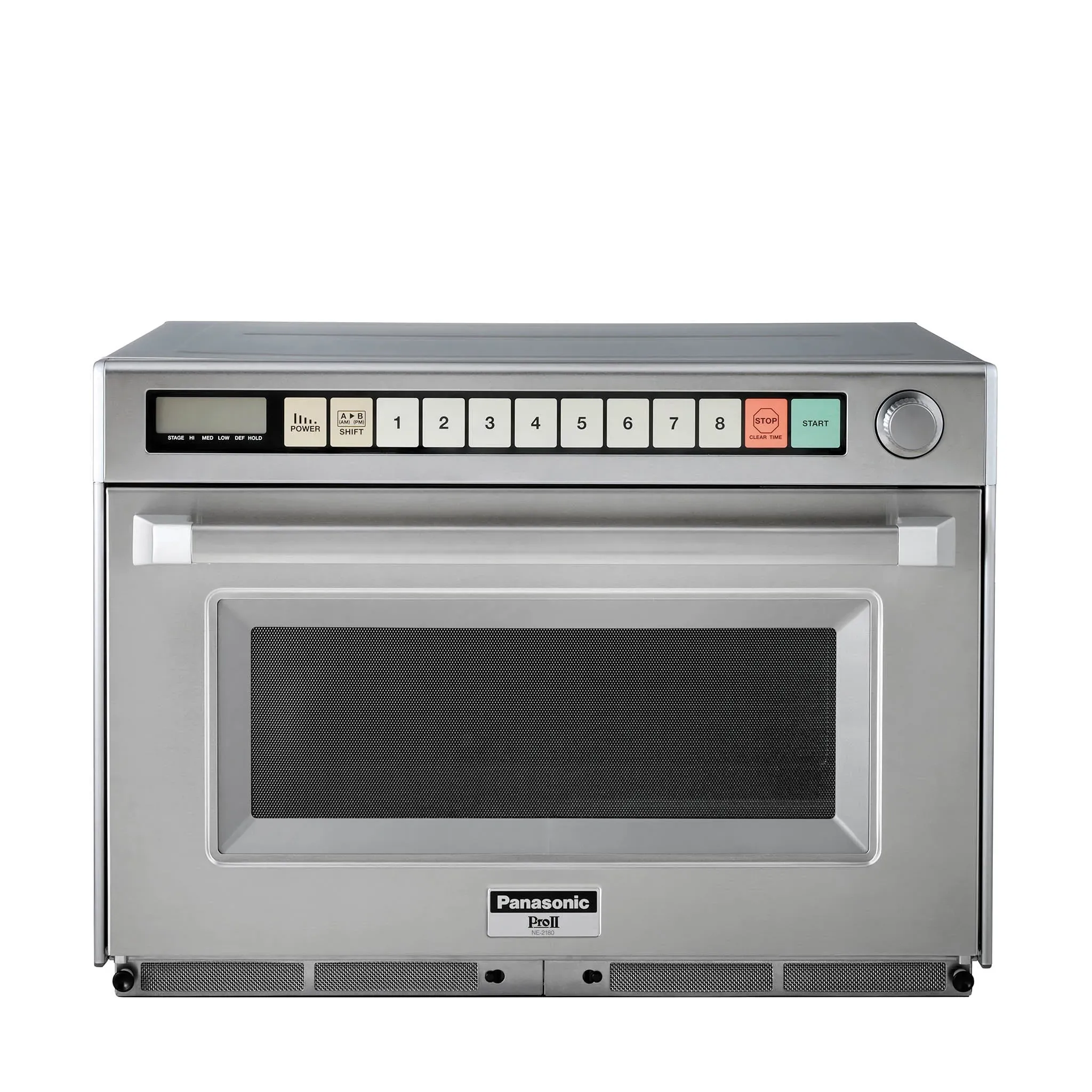
1. Best Overall (The Heavyweight): Panasonic Sonic Steamer (2100W)
- Best For: High volume fast-casual (Chipotle style), steaming veggies.
- Why It Wins: It uses Inverter Technology to simmer food gently or blast it with 2100 Watts. It has dual magnetrons for redundancy.
- Speed: It heats soup in 30 seconds.
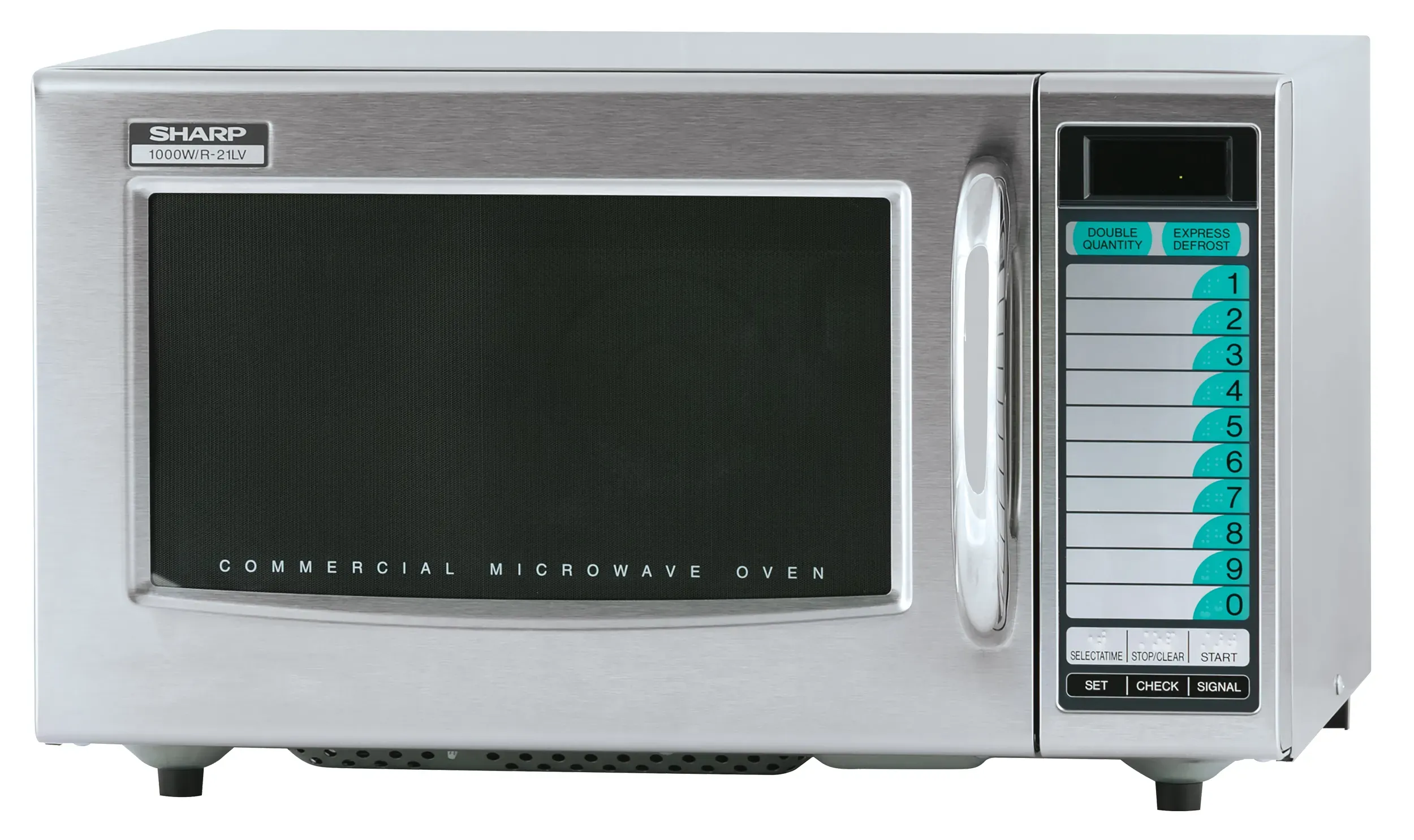
2. Best Value (The Workhorse): Sharp R-21LVF
- Best For: Prep kitchens, warming desserts.
- Why It Wins: Use the Dial version. It is indestructible. The “Express Defrost” is surprisingly accurate.
- Durability: The latch mechanism is simple and rarely breaks.
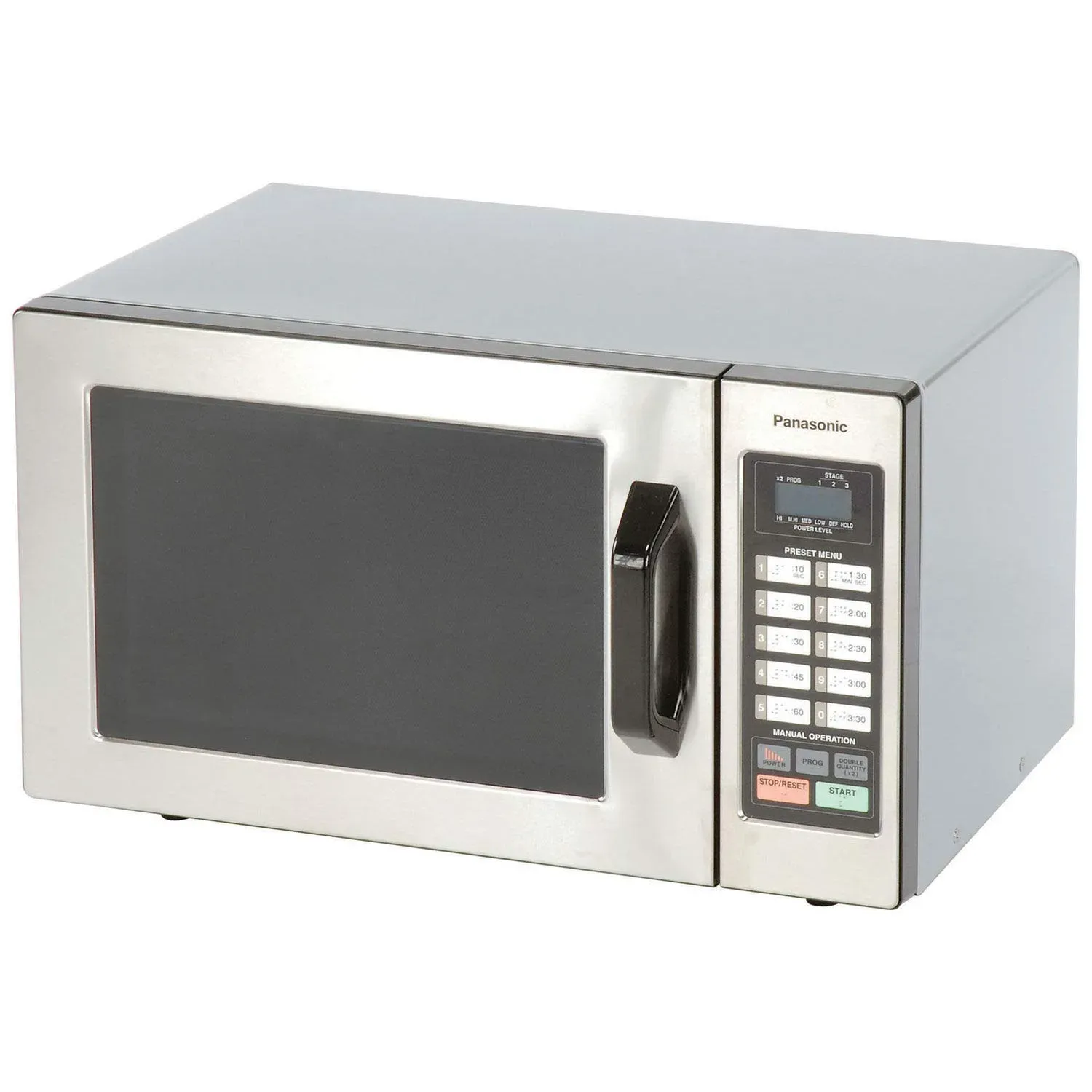
3. Best Compact (The Standard): Panasonic NE-1054
- Best For: Waitress stations, coffee shops.
- Why It Wins: The bottom-fed energy eliminates the need for a turntable. It fits on a 12” shelf.
- Reliability: It is the Honda Civic of microwaves. It runs forever.
Final Summary
If you are a high-volume kitchen, buy the Sonic Steamer. It pays for itself in time. If you just need to melt butter, buy the NE-1054.